
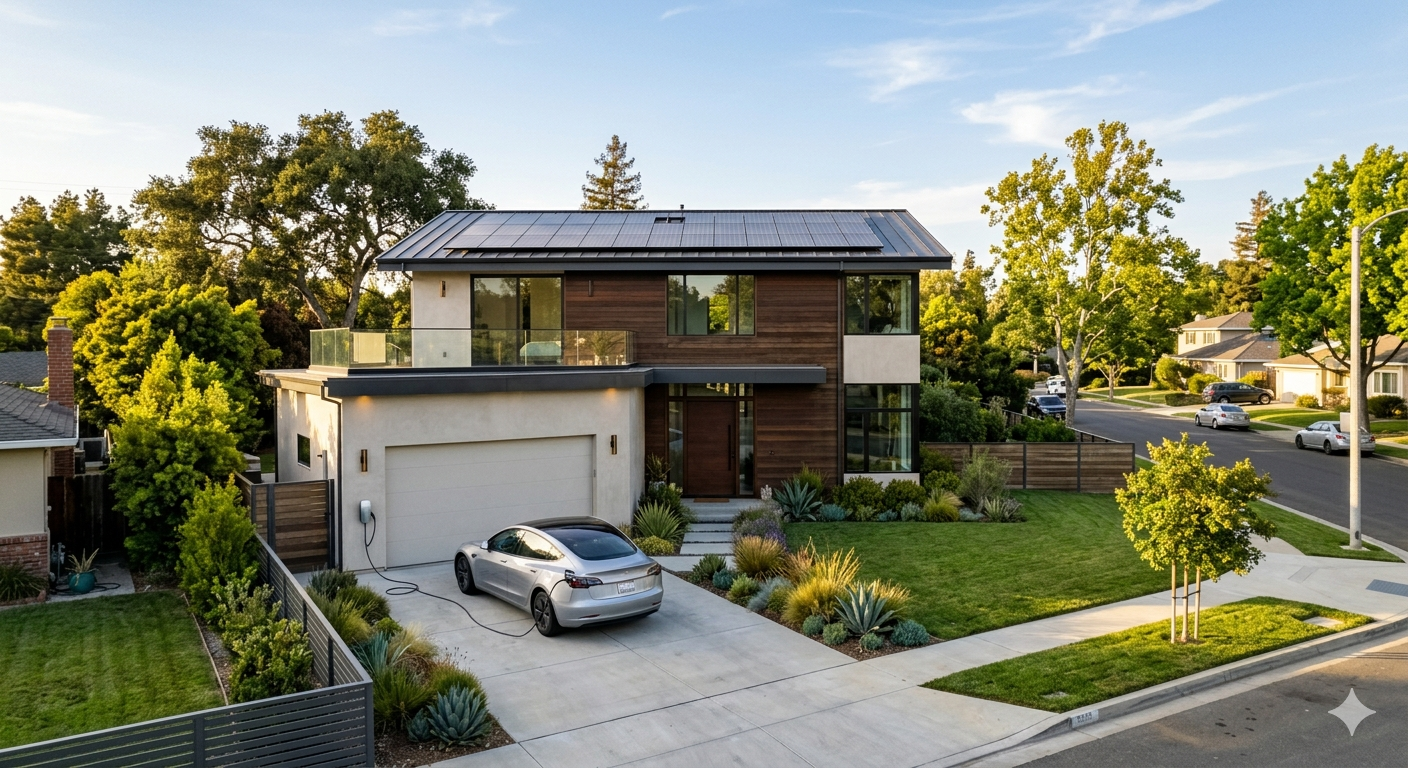
California's Energy Bills
Are Out of Control.
Here's How to Fix Yours.
Whether you're on PG&E, SMUD, SCE, or SDG&E — the playbook is the same. Solar, battery storage, smart upgrades, and the right sequence. This is the complete guide to taking control of your energy costs for good.
Get Your Free Energy Consultation →Serving PG&E · SMUD · SCE · SDG&E territories across California
Why Every California Electric Bill
Keeps Climbing — Regardless of Your Utility
California homeowners pay some of the highest electricity rates in the continental United States — and the problem is getting worse, not better.
It doesn't matter whether your bill comes from PG&E, SDG&E, SCE, or SMUD. Every major California utility has moved to Time-of-Use (TOU) rate structures that charge peak prices between 4–9pm every day — exactly when most families are home cooking dinner, running appliances, and cooling the house after a long day.
California utilities have averaged 6–8% annual rate increases over the past decade, according to CPUC data. A bill that costs $250 today becomes $400 within five years at that pace — without any change in your usage. Meanwhile, NEM 3.0, which took effect for new solar customers in April 2023, dramatically reduced the value of excess solar sent back to the grid on PG&E, SCE, and SDG&E. Solar-only systems installed today earn roughly 75% less in export credits than systems installed before the change.
The result: piecemeal solutions — efficiency upgrades alone, or solar without storage — no longer move the needle the way they once did. The homeowners winning against rising utility bills are the ones who treat their home as a complete energy system, not a collection of disconnected upgrades.
2025–2026 California Utility Rate Comparison| Utility | Avg Blended Rate | Peak Window | NEM Status | Battery Priority |
|---|---|---|---|---|
| PG&E | ~$0.38/kWh | 4–9pm daily | NEM 3.0 | Essential |
| SDG&E | ~$0.47/kWh Highest in US | 4–9pm daily | NEM 3.0 | Essential |
| SCE | ~$0.32/kWh | 4–9pm daily | NEM 3.0 | Essential |
| SMUD | ~$0.13/kWh | 5–8pm weekdays | NEM 2.0 Active | Recommended |
Rates are blended averages based on published utility tariff schedules. Actual rates vary by usage tier, baseline territory, and rate plan. Sources: PG&E, SDG&E, SCE, and SMUD published rate schedules; CPUC 2024.
SMUD customers: Sacramento's municipal utility still operates under NEM 2.0, meaning solar-only systems still pencil well without battery storage. Battery backup adds meaningful additional value — SMUD offers a rebate of up to $5,400 per Powerwall, plus a $440/year Virtual Power Plant enrollment credit (Tesla Powerwall only) for customers who enroll within 90 days of Permission to Operate. Rebate amounts subject to change — verify current amounts at smud.org.
The 5-Step Sequence California Homeowners
Use to Eliminate Their Energy Bills
Going all-electric isn't one purchase — it's a sequence. Each step builds on the last, and the order matters. Here's the framework that works across every California utility territory.
Solar panels are the foundation. They generate clean electricity from sunlight and offset what your home pulls from the grid. On NEM 3.0 utilities (PG&E, SCE, SDG&E), solar works best when paired with battery storage — excess solar charges the battery rather than exporting to the grid at low rates. On SMUD (NEM 2.0), solar-only systems still pencil well, though storage adds meaningful outage protection.
A home battery captures excess solar during the day and discharges during the 4–9pm peak window — the hours when grid electricity costs the most across all four major California utilities. The result: you're buying little to no expensive peak power from the grid. Battery storage also provides whole-home backup during PG&E PSPS events and grid outages, which are increasingly common across California. For PG&E, SCE, and SDG&E customers, battery storage is no longer optional if you want solar to fully pencil.
HVAC accounts for 40–50% of a California home's electric load (California Energy Commission). A smart thermostat pre-cools your home before 4pm using cheaper off-peak electricity, then coasts through the expensive peak window with minimal grid draw. Every major California TOU rate schedule rewards this behavior directly. Works with every utility.
A Level 2 home charger lets you charge your EV overnight during off-peak hours — midnight to 6am on most California TOU schedules — when electricity is cheapest. Paired with solar, overnight charging can be essentially free. The average California driver spends $150–$250/month on gas; a home EV charger eliminates that entirely while adding roughly $20–$40/month to your electric bill charged off-peak.
Gas lawn equipment is the last fossil fuel holdout in most California homes — and the state is closing that door. California's AB 1346 banned the sale of new gas-powered lawn mowers, leaf blowers, and trimmers effective January 2024. When your current gas mower dies, a new gas replacement is no longer available at retail in California. Robot mowers are the cleanest, quietest, lowest-maintenance replacement — and if your home runs on solar, they operate at zero fuel cost. Learn more on our gas-free lawn guide.
Does Solar Still Make Sense in California in 2026?
The Honest Answer — by Utility
Yes — but the strategy has changed. NEM 3.0 didn't kill solar in California. It changed solar from an export game into a self-consumption game. Here's what that means for your home.
Before April 2023, California solar customers on PG&E, SCE, and SDG&E could send excess solar to the grid during the day and receive near-retail credits on their bill. That's NEM 2.0 — and it made solar-only systems highly profitable. NEM 3.0 reduced those export rates by roughly 75%, meaning sending power to the grid now earns far less than buying it back later.
The solution is straightforward: keep the solar on-site. A properly sized battery captures daytime solar generation and discharges it during evening peak hours — the exact window you'd otherwise be paying the most for grid power. Self-consumption rates of 90–100% are achievable with the right system design. The economics work. They just work differently than they did before 2023.
NEM 2.0 vs. NEM 3.0 — What Changed
- Export credits at near-retail rates
- Solar-only systems pencil well
- Battery adds backup value, not bill math
- Faster payback on solar-only installs
- SMUD customers: act before NEM 2.0 ends
- Export credits ~75% lower than NEM 2.0
- Solar + battery required to fully pencil
- Self-consumption is now the strategy
- Battery charges from solar, discharges at peak
- System design matters more than ever
The Prepaid Lease: 30% Off Upfront — No Tax Liability Required
Since the federal residential solar tax credit (ITC) is no longer available to individual homeowners, most California families are using a prepaid lease structure to access the same savings without needing a tax liability.
Here's how it works: a third-party system owner purchases and installs the solar and battery system. They claim the investment tax credit — and pass the 30% savings directly to you as an upfront discount on the system price. You pay roughly 70 cents on the dollar. After 5 years, you have the option to take full ownership.
Best Strategy by California Utility
The right system design depends on who your utility is. Here's the honest breakdown:
Want to Know What Solar + Battery Looks Like for Your Home?
We'll review your utility bill, run the numbers for your specific utility and usage, and show you exactly what a system costs — and saves — before you commit to anything.
Get Your Free Estimate →Serving PG&E · SMUD · SCE · SDG&E · No pressure, no obligation
Which Smart Thermostat Saves the Most Money
on California TOU Rate Plans?
For California homeowners on Time-of-Use rate plans, the Ecobee Premium and Nest Learning Thermostat are the top two options — both support custom scheduling around peak windows, both qualify for most California utility rebates, and both are ENERGY STAR certified. Pre-cooling your home before 4pm using cheaper off-peak power, then coasting through the expensive peak window, can reduce HVAC costs by 15–20% on its own.
| Thermostat | TOU Scheduling | Room Sensors | ENERGY STAR | Utility Rebate | Best For | Shop |
|---|---|---|---|---|---|---|
| Nest Learning | ✓ | Add-on | ✓ | ✓ Most CA utilities | Simplicity | Shop |
| Ecobee Premium | ✓ | ✓ Included | ✓ | ✓ Most CA utilities | Multi-room | Shop |
| Amazon Smart | ✓ | No | ✓ | Limited | Budget | Shop |
Utility rebate eligibility varies by program and model year. Check PG&E, SMUD, SCE, or SDG&E rebate portals for current amounts before purchasing. Links are affiliate links — we may earn a commission at no cost to you.
Energy-Efficient Home Appliances
That Qualify for California Rebates
Replacing gas appliances with electric alternatives is the next layer of the all-electric home strategy. Heat pump water heaters use 60–70% less energy than standard electric resistance water heaters (U.S. Department of Energy) and qualify for rebates through most California utilities. Heat pump HVAC systems provide both heating and cooling at 2–3x the efficiency of traditional systems.
LG's lineup of ENERGY STAR certified appliances covers both categories — and California utility rebate programs often stack with manufacturer promotions, reducing the effective out-of-pocket cost significantly.
California utility rebates for heat pump appliances vary by program and availability. Check your utility's rebate portal before purchasing to confirm current amounts. Link is an affiliate link — we may earn a commission at no cost to you.
Best Home EV Charger for
California TOU Rate Plans in 2026
For California homeowners on Time-of-Use rate plans, a Level 2 home charger that supports scheduled overnight charging is essential. The difference between charging at peak versus off-peak rates can exceed $100 per month — and paired with solar, overnight EV charging can be effectively free.
The average California driver spends $150–$250/month on gasoline. A Level 2 home charger eliminates that cost while adding roughly $20–$40/month to your electric bill when charged during off-peak hours. Every major California utility offers a dedicated EV rate plan that lowers overnight charging costs further.
| Charger | Max Output | Installation | Scheduling | Non-Tesla Compatible | Energy Monitor | Best For | Shop |
|---|---|---|---|---|---|---|---|
| ChargePoint Home Flex | 50A / 12kW | Hardwired or plug-in | ✓ | ✓ | ✓ | Universal | Shop |
| Emporia Level 2 | 48A / 11.5kW | Hardwired | ✓ | ✓ | ✓ Built-in | Energy Data | Shop |
| Tesla Wall Connector | 48A / 11.5kW | Hardwired | ✓ | ✓ w/ adapter | Limited | Tesla Owners | Shop |
| Lectron L1/L2 Portable | 40A / 9.6kW | No install needed | LED only | ✓ J1772 | No | No Electrician | Shop |
Amperage and output figures represent maximum rated capacity. Actual charging speed depends on your EV's onboard charger limit. Hardwired installation requires a licensed electrician and a dedicated 240V circuit. Links are affiliate links — we may earn a commission at no cost to you.
The Lectron Level 1/2 portable charger plugs directly into any NEMA 14-50 outlet — the same 240V outlet used by RVs and electric dryers. No electrician, no permit, no panel upgrade required. It delivers up to 9.6kW of Level 2 charging speed, adding 25–30 miles of range per hour. ETL certified and compatible with all J1772 EVs. The most accessible entry point to home EV charging available.
EV rate plan details and pricing change periodically. Always verify current rates directly with your utility before switching plans. SMUD rate confirmed January 1, 2026. Other utility rates vary by season, income tier, and plan. Links go to each utility's official rate page.
What's the Best Battery Backup for a
California Home That Doesn't Have Solar Yet?
You don't have to wait for a full solar + battery installation to protect your home from grid outages. Portable power stations are a legitimate starting point — and for many California homeowners, they're the first step on the path to full energy independence.
California's grid has become increasingly unreliable. PG&E's Public Safety Power Shutoff (PSPS) program cuts power to hundreds of thousands of homes each year during fire weather conditions. Extreme heat events strain the grid statewide. The question isn't whether you'll lose power — it's whether you'll be prepared when it happens.
PG&E's PSPS program has affected millions of customers since 2019. SCE and SDG&E operate similar shutoff programs across Southern California. Even SMUD customers face outage risk during extreme heat events and regional grid stress. A backup power source — whether portable or whole-home — is no longer a luxury in California. It's a practical necessity.
BLUETTI makes some of the most capable portable power stations available for California homeowners. Models range from compact units for essentials to large-capacity stations that can power a refrigerator, CPAP, and lights through a multi-day outage. Solar panel input lets you recharge from the sun during an extended shutoff — no grid required.
buying guide on our
BLUETTI page
All-Electric Home California:
Frequently Asked Questions
Straight answers to the questions California homeowners ask most about going all-electric — across PG&E, SMUD, SCE, and SDG&E territories.
An all-electric home is a residence that uses electricity — rather than natural gas or propane — to power all of its major systems: heating and cooling (heat pump HVAC), water heating (heat pump water heater), cooking (induction range), clothes drying (heat pump dryer), and transportation (EV charging). When paired with rooftop solar and battery storage, an all-electric home can generate most or all of its own energy, dramatically reducing or eliminating monthly utility bills.
The cost depends on which upgrades you prioritize and how you finance them. A solar + battery system typically runs $25,000–$60,000 before incentives, depending on system size. A heat pump water heater costs $1,200–$2,500 installed. A heat pump HVAC system ranges from $5,000–$15,000 depending on home size. A Level 2 EV charger runs $500–$1,500 installed.
Most California homeowners don't pay full price. The prepaid lease structure passes a 30% upfront discount on solar + battery systems — no tax liability required. Utility rebates are available for heat pump water heaters and HVAC across PG&E, SMUD, SCE, and SDG&E. Many upgrades qualify for additional state and federal incentives under the Inflation Reduction Act.
Yes — for most California homeowners, a properly designed all-electric upgrade pays for itself. California has some of the highest electricity and gas rates in the country. SDG&E customers pay roughly $0.47/kWh blended, PG&E customers around $0.38/kWh. Every kWh generated by your own solar and stored in a battery avoids paying those rates entirely.
Solar + battery systems typically pay back in 8–9 years for California homeowners, after which the system generates effectively free energy for the remaining 15+ years of its useful life. Heat pump water heaters pay back in 2–4 years through energy savings alone. EV charging at home saves the average California driver $150–$250/month compared to gasoline.
NEM 3.0 (Net Energy Metering 3.0) is the current billing structure for new solar customers on PG&E, SCE, and SDG&E, effective April 2023. Under NEM 3.0, the credits you receive for sending excess solar back to the grid are roughly 75% lower than under the previous NEM 2.0 program.
This doesn't mean solar is no longer worth it — it means the strategy has changed. Under NEM 3.0, the goal is to use your own solar generation on-site rather than export it. A battery stores excess daytime solar and discharges it during the 4–9pm peak window, maximizing self-consumption and minimizing grid purchases at expensive peak rates. SMUD remains on NEM 2.0, making solar-only systems more viable in Sacramento than in PG&E or SCE territory.
Yes — solar paired with battery storage remains one of the strongest investments available to California homeowners in 2026. California electricity rates are among the highest in the continental US and continue to rise 6–8% annually on average. Every year without solar means another year of paying those increasing rates with no return.
The key shift since NEM 3.0 is that battery storage is now essential for PG&E, SCE, and SDG&E customers to capture full value from a solar system. A solar-only system under NEM 3.0 earns far less in export credits than it would have before April 2023. A solar + battery system sidesteps this by using generation on-site — the economics remain strong.
SDG&E (San Diego Gas & Electric) has the highest residential electricity rates of any major utility in the United States, with a blended average of approximately $0.47/kWh as of 2026. PG&E follows at roughly $0.38/kWh blended, and SCE at approximately $0.35/kWh. SMUD (Sacramento Municipal Utility District) is the outlier — as a publicly owned municipal utility, SMUD's rates are significantly lower at approximately $0.13/kWh blended, more than 50% below PG&E's rates for comparable usage.
The practical implication: SDG&E and PG&E customers have the strongest financial case for solar + battery storage, while SMUD customers benefit most from the remaining NEM 2.0 export credits and available battery rebates.
Going all-electric means replacing gas-powered appliances with efficient electric alternatives. The main upgrades are: gas furnace → heat pump HVAC system; gas water heater → heat pump water heater; gas range → induction cooktop or range; gas dryer → heat pump dryer; and gas vehicle → electric vehicle with home charger.
You don't need to replace everything at once. Most California homeowners prioritize based on age of existing appliances and rebate availability. Heat pump water heaters typically offer the fastest payback and are the most common first upgrade. HVAC is usually replaced at end of system life. Solar and battery storage can be added at any stage of the electrification process.
A single Tesla Powerwall 3 holds 13.5 kWh of usable energy. How long it lasts during an outage depends entirely on your home's load. A California home running essential loads only — refrigerator, lights, phone charging, router, and a few fans — typically uses 1–2 kWh per hour, meaning one Powerwall can provide 7–13 hours of backup on essentials alone.
Two Powerwalls (27 kWh total) is the most common configuration for whole-home backup in California. With solar panels recharging the batteries during daylight hours, a two-Powerwall system can sustain a home through a multi-day outage indefinitely as long as the sun is shining. Running central air conditioning, electric vehicle charging, or electric cooking significantly increases load and reduces backup duration.
Yes — SMUD (Sacramento Municipal Utility District) still operates under NEM 2.0, making it one of the last major California utilities to offer near-retail export credits for excess solar. New solar customers interconnecting with SMUD receive credits at rates significantly higher than PG&E, SCE, or SDG&E customers under NEM 3.0.
SMUD also offers a battery rebate of up to $5,400 per Powerwall, plus a $440/year Virtual Power Plant enrollment credit for Tesla Powerwall customers who enroll within 90 days of Permission to Operate. Rebate amounts are subject to change — verify current figures at smud.org. SMUD's combination of NEM 2.0 export credits, lower base rates, and battery rebates makes Sacramento one of the strongest solar markets in California despite having the lowest utility rates of the four major utilities.
For California homeowners on Time-of-Use rate plans, the Ecobee Premium and Nest Learning Thermostat are the top two options. Both support custom TOU scheduling — allowing you to pre-cool your home before the 4pm peak window begins and coast through the expensive evening hours with minimal grid draw. Both are ENERGY STAR certified and qualify for rebates through most California utilities including PG&E, SMUD, SCE, and SDG&E.
The Ecobee Premium includes room sensors out of the box, making it the stronger choice for larger homes or homes where temperature varies significantly between rooms. The Nest Learning Thermostat is simpler to set up and integrates well with Google Home ecosystems. For budget-conscious homeowners, Kasa smart plugs offer a lower-cost way to schedule individual high-draw appliances around TOU peak windows without replacing the thermostat.
Still Have Questions About Your Home?
Every home is different. We'll review your utility bill, usage patterns, and goals — and give you a straight answer about what makes sense for your situation.
Get Your Free Consultation →Serving PG&E · SMUD · SCE · SDG&E · No pressure, no obligation
Solar With Watts Serves
All of California
We design and install solar, battery storage, and energy systems across PG&E, SMUD, SCE, and SDG&E territory statewide. Every page below includes utility-specific rate data, local bill benchmarks, and product options built for that area.
Ready to Take Control of
Your Energy Bill?
Tell us about your home, your utility, and your goals. We'll put together a system design and savings estimate — no pressure, no obligation.
Get Your Free Estimate →Serving PG&E · SMUD · SCE · SDG&E · Pioneer · All of California