Solar + Airbnb Hosting in California: Earn Twice (2026)
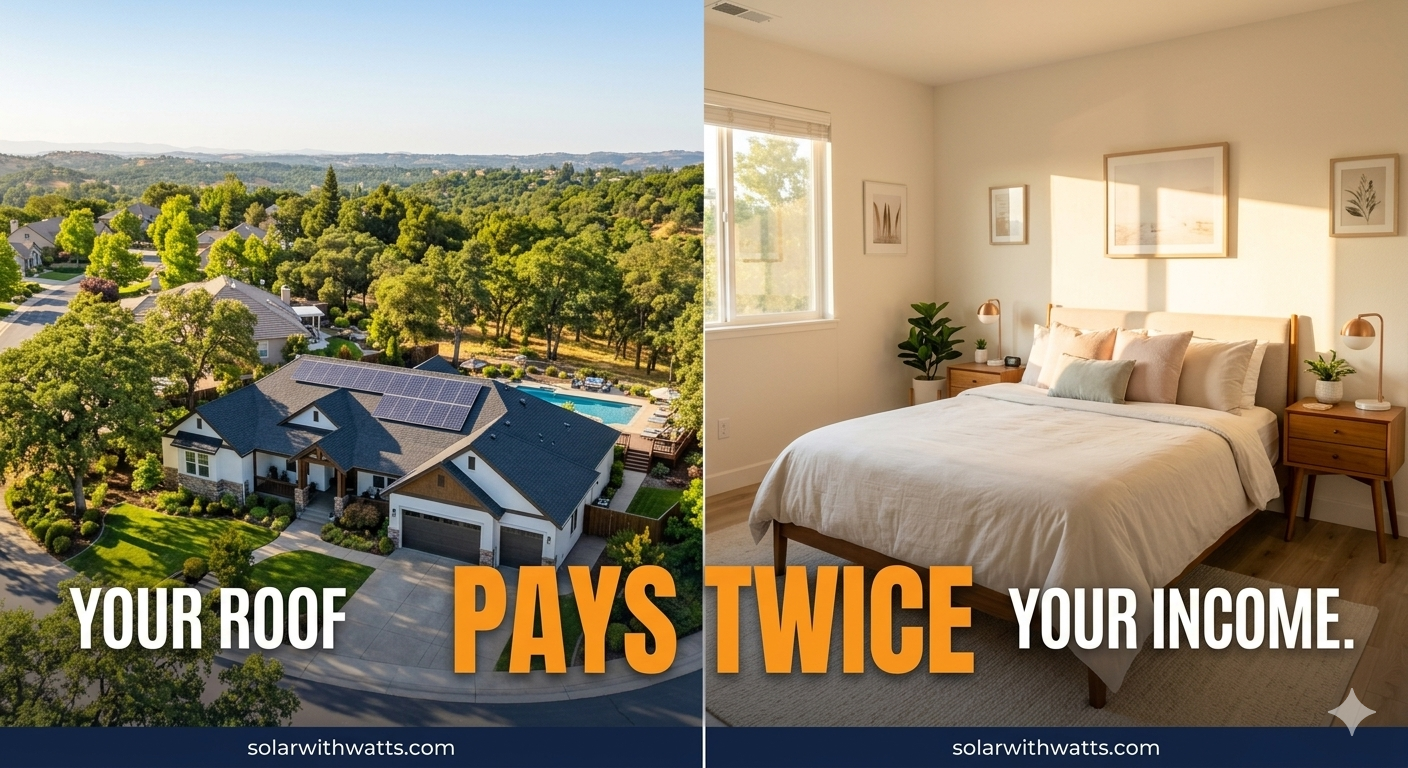
Solar + Airbnb:
The Combo That
Pays Twice
Most California homeowners weigh Airbnb hosting and solar as two separate decisions. Paired correctly, they create two income streams from one home — and each makes the other more valuable.
Free solar estimate · No obligation · Airbnb setup is free
Yes — pairing solar with Airbnb hosting improves your home's economics in California. Solar covers the extra electricity a guest room uses at no added cost, while hosting a spare room typically brings in $800–$2,000 a month. In SMUD territory, battery rebates and ongoing VPP payments stack on top of both.
Why These Two Decisions Work Better Together
California electricity rates keep climbing — PG&E residential rates have risen roughly 54% since 2020, according to PG&E's own reporting to state regulators. At the same time, spare bedrooms across the state sit empty most nights. Solar and Airbnb hosting each show up on a lot of homeowners' to-do lists, but treated separately, neither feels urgent enough to act on.
The two decisions are dramatically better together. Solar cuts the added operating cost of hosting. Hosting income makes the case for going solar easier to justify. A battery protects both. In California specifically — with peak utility rates, PSPS outages, and a fast-growing EV-driving guest base — the combination creates advantages neither investment delivers alone.
This post covers the real numbers, which California utility territories benefit most, and what to put in your Airbnb listing to turn solar and battery into a booking advantage.
What Do Two Income Streams From One Home Actually Look Like?
Before the mechanics, here's the headline financial picture for a typical homeowner doing both:
Solar + Battery Savings
Reducing or eliminating your PG&E, SMUD, SCE, SDG&E, or LADWP bill is income-equivalent — money that stays in your pocket every month instead of going to the utility.
Airbnb Spare Room Income
Hosting a spare bedroom 12–18 nights a month at typical California market rates generates meaningful supplemental income — with solar covering the added electricity load.
Illustrative example based on average California residential utility bills and a typical 8–9 kW solar + battery system. Airbnb figures are general market illustrations, not a guarantee — actual nightly rates and occupancy vary significantly by city, season, and listing quality. Airbnb net accounts for a 3% host platform fee. Always run your own numbers for your specific home and market before deciding.
How Does Solar Make Airbnb Hosting More Profitable?
Solar improves the economics of hosting a spare room directly — and it's not just the sustainability angle.
Hosting Adds Electricity Load — Solar Covers It for Free
Hosting 14 nights a month adds real consumption: AC in the guest room, extra laundry, constant device charging, streaming, exterior lighting. On peak time-of-use rates, that added load can cost $40–$80/month. A properly sized solar + battery system covers that load from stored solar energy instead, so your cost per hosted night stays flat as bookings scale up.
A Battery Makes Outages a Non-Issue for Guests
California hosts in fire-risk zones — El Dorado Hills, Vacaville, Brentwood, the foothills — lose bookings when a PSPS shutoff hits and the listing goes dark. A guest who books a home promising Wi-Fi and AC and arrives to neither tends to leave a bad review. A Tesla Powerwall or similar home battery keeps the guest room, router, refrigerator, and lights running through an outage automatically. Use the Powerwall savings calculator to estimate what backup coverage would cost for your home.
An EV Charger Powered by Solar Is a Real Booking Advantage
According to Airbnb's own data, listings offering an EV charger are booked for more nights on average than listings without one, and searches using Airbnb's EV charger filter grew more than 80% between 2022 and 2023 — with California leading the nation in EV registrations. A Level 2 (240V) charger powered by your solar system costs nothing to operate and differentiates your listing from every other generic spare room in your ZIP code.
Solar-Powered Listings Attract a Growing Guest Segment
Airbnb encourages hosts to highlight energy efficiency in listing descriptions to reach sustainability-minded travelers. A listing that leads with "solar-powered, EV charging, battery backup included" targets guests willing to pay a premium — and this segment tends to leave positive reviews when the claim holds up.
Which California Utility Territory Benefits Most From This Combination?
The solar + hosting combination works across California — but the financial mechanics differ depending on where your home is.
| Utility | Solar value driver | Battery value driver | Hosting market | Combo rating |
|---|---|---|---|---|
| PG&E | High peak rates · NEM 3.0 makes storage important | PSPS protection · peak-rate offset | Sacramento, Folsom, El Dorado Hills, Vacaville, Bay Area suburbs | Strongest |
| SMUD | Lower rates, but up to $5,400/Powerwall rebate + up to $880/yr VPP for 2 units | VPP income stacks on hosting income · no PSPS exposure | Sacramento, Elk Grove, Rancho Cordova, Folsom | Strongest |
| SCE | High peak rates · NEM 3.0 applies | Peak-rate offset · Central Valley heat drives high AC loads | Visalia, Fresno, Bakersfield, Central Valley | Strong |
| SDG&E | Among the highest peak rates in the state | Battery offset is especially strong at SDG&E's time-of-use spread | San Diego County — dense, year-round tourist demand | Strong |
| LADWP | Program details being finalized for LADWP customers | Program details being finalized for LADWP customers | Los Angeles — one of the largest Airbnb markets in the country | Check Eligibility |
LADWP program and rate details are being finalized on our end — get a free estimate and we'll confirm current options for your specific address.
How Does Airbnb Income Change the Case for Going Solar?
Here's a comparison most solar advisors don't walk through: what the monthly cash-flow picture looks like with and without hosting income layered on top of solar.
| Monthly cash flow | Solar only | Solar + battery + Airbnb hosting |
|---|---|---|
| System cost (financed) | ~$22,000 | ~$22,000 |
| Monthly bill savings | $150–$250 | $200–$350 (incl. $0 hosting electricity cost) |
| Airbnb spare-room income | — | $800–$2,000/mo |
| Net monthly cash flow vs. no solar | Positive, gradual | Substantially positive from month one |
Hosting income doesn't erase your solar financing payment on paper — but when a spare room is bringing in $800–$2,000/month with zero added electricity overhead because solar covers the load, that income comfortably covers the system payment with room to spare. The two decisions reinforce each other from the first month, not years down the line.
Curious what solar would cost for your home and how it changes your numbers? Free estimate — most done virtually within 48 hours.
See My Solar Savings →What Should You Put in Your Airbnb Listing If You Have Solar?
Having solar and a battery is worth nothing to your hosting income if guests can't find it in your listing. Here's what to put in your description and amenity checkboxes to turn your energy setup into a booking advantage.
What to Highlight in Your Listing Description
What's the SMUD Territory Advantage?
If you're in SMUD territory — Sacramento, Elk Grove, Rancho Cordova, Folsom — you have an incentive stack no other California utility market matches, and it layers cleanly on top of Airbnb hosting income.
The SMUD host stack:
- →SMUD battery rebate: up to $5,400 per Tesla Powerwall (cap $10,000/household) — reduces your system cost significantly
- →VPP program: up to $880/year for two Powerwalls in Virtual Power Plant income — ongoing passive income on top of hosting income
- →SMUD uses a flat export rate, not NEM 3.0 — simpler solar math
- →Folsom and Elk Grove are active, well-reviewed Airbnb markets in the Sacramento region
A SMUD homeowner with two Powerwalls, solar on a prepaid lease, and a spare room on Airbnb stacks: battery rebates (up to ~$10K one-time), up to $880/yr in VPP income, a reduced monthly utility bill, and $800–$2,000/mo from hosting. Run your own numbers with the Powerwall savings calculator before committing.
SMUD rebate and VPP amounts subject to change — always verify current figures at smud.org before committing.
Thinking about starting your Airbnb listing? Setup is free — no obligation to accept bookings until you're ready.
Start Free Airbnb Setup →Should You Start With Solar or Airbnb Hosting First?
Start with Airbnb hosting if: you have a spare room ready to use right now, want income with zero upfront cost, and would like that income to help offset solar financing later.
Start with solar if: your electricity bill is your biggest monthly pain point, you're in SMUD territory and want to capture the battery rebate, or you're planning to host and want zero electricity overhead from day one. A solar PPA or lease option can get you started with no upfront cost either way.
Do both at once if: you're in Pioneer Community Energy territory and want to explore the GridGen program (no credit check, $0 down), or you're in a high-bill territory with a guest-ready spare room already.
Most California homeowners can start Airbnb hosting within 2–3 weeks. Most solar projects complete within 30–45 days. There's no reason to wait on one while you sort out the other.
Frequently Asked Questions
Run the Numbers on
Both — Free.
Get a free solar estimate for your home and explore starting your Airbnb listing — two income streams, one conversation. Most solar estimates are done virtually within 48 hours. Airbnb setup takes about an hour and is free to start.
Solar With Watts · (209) 216-8180 · Shingle Springs, CA · Serving PG&E, SCE, SMUD, SDG&E & LADWP territories
Ed Watts is the founder of Solar With Watts, a California home energy company based in Shingle Springs, CA. He has 10 years of experience in residential solar, home batteries, and home energy optimization across PG&E, SCE, SMUD, SDG&E, and LADWP territories. This post contains an affiliate link — if you use the Airbnb link above to start hosting, Ed may earn a commission at no cost to you. Airbnb income figures are general market illustrations, not guarantees; actual results vary by city, season, and listing quality. SMUD rebate and VPP amounts subject to change — verify current figures at smud.org before committing. LADWP program details are pending confirmation.