Home EV Charging Costs in California 2026: PG&E, S.D.G.&E, SMUD & SCE Rates
Before You Go —
Get the Free Solar Guide
The California Solar Guide 2026 — updated with real PG&E, SMUD, SCE & SDG&E rate data, the ITC expiration, NEM 3.0 math, and what EV owners actually save with solar.
- ✓Real payback timelines by utility — not industry averages
- ✓EV + solar savings: what $0.017/mile actually requires
- ✓Lease vs. PPA vs. cash — the honest comparison
- ✓Battery storage: SGIP rebates + SMUD $5,400 Powerwall incentive
No spam. One email with your guide. Unsubscribe anytime.
$0.48/kWh at the Supercharger vs. $0.017/Mile on Solar — California EV Charging Costs 2026
PG&E, SMUD, SCE & SDG&E Rates · Level 2 Install Cost · What Solar Actually Changes
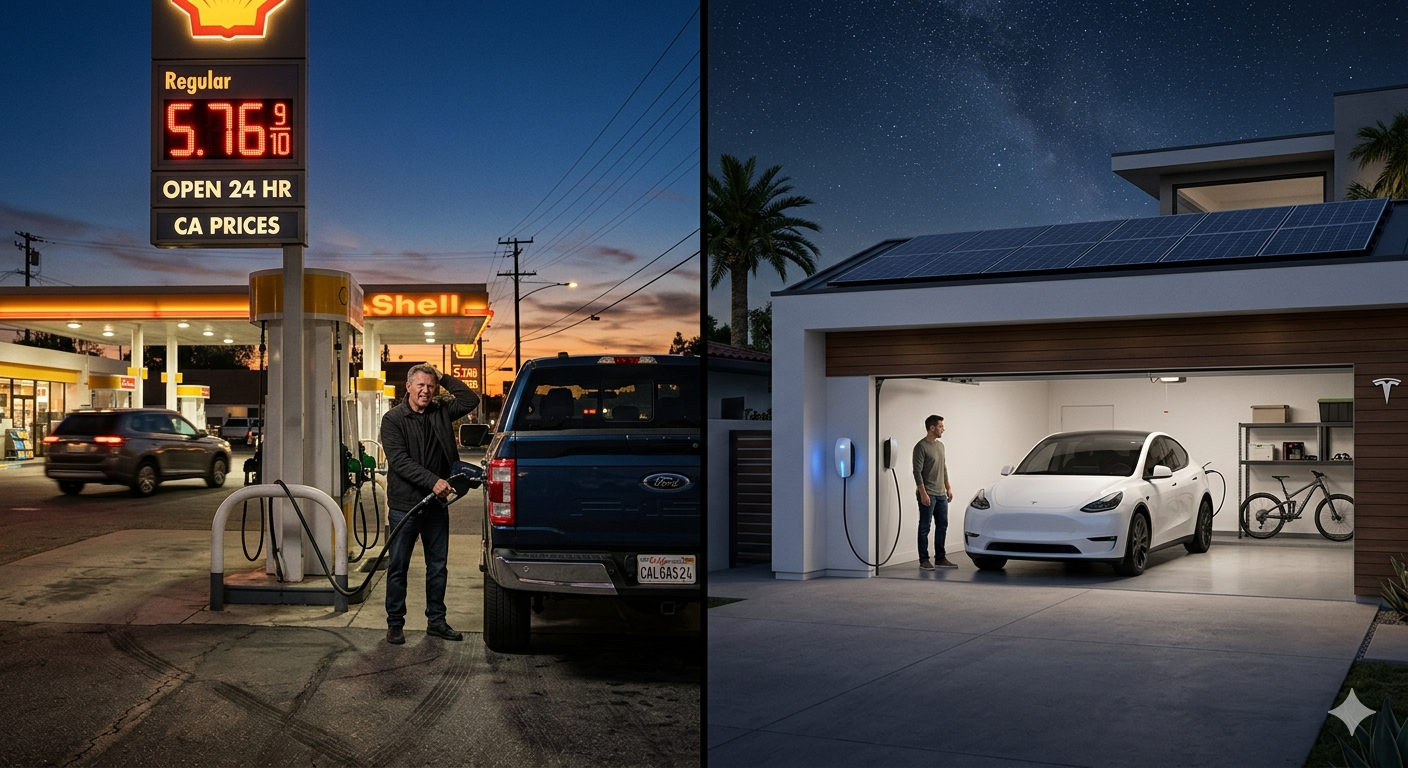
California Tesla Superchargers average $0.42–$0.48/kWh in 2026 — roughly $0.13 per mile. Charging at home off-peak on PG&E costs $0.18/kWh, or $0.051/mile — less than half the Supercharger rate. Solar self-consumption drops that to $0.017/mile — 13 times cheaper than gas at California's current $6.15/gallon average. Level 2 home charger installation labor runs $500–$900 for most California homes, with the federal 30C tax credit covering 30% of qualified costs through June 30, 2026.
This guide covers real 2026 kWh rates for every major California utility per official rate schedules, a head-to-head Supercharger vs. home charging comparison, what Level 2 charger installation actually costs in California, and the math on what solar changes. Per EIA state electricity data, California has the highest residential electricity rates in the continental U.S. — making the choice of when and how you charge more consequential here than anywhere else.
What Does Tesla Supercharger Cost vs. Home Charging in California 2026?
The most important number is cost per kWh — that determines your real cost per mile. According to Tesla's published Supercharger pricing, California Supercharger rates average $0.42–$0.48/kWh in 2026. Per PG&E Schedule E-TOU-C, off-peak home charging runs $0.18/kWh. Here's how every scenario stacks up.
| Charging Method | Rate ($/kWh) | Cost Per Mile | Monthly Cost 1,000 mi/mo · 3.5 mi/kWh |
Type |
|---|---|---|---|---|
| Solar Self-Consumption NEM 3.0 — use your own panels during day or stored battery · CPUC Net Billing | $0.05–0.08 | $0.017 | ~$17 | Best |
| Home — Off-Peak Grid PG&E midnight–6 AM · Smart scheduling required · E-TOU-C Rate | $0.18 | $0.051 | ~$51 | Home |
| Home — Peak Hours (4–9 PM) Most expensive home charging — PG&E TOU rate · E-TOU-C | $0.45–0.55 | $0.143 | ~$143 | Home |
| Tesla Supercharger — California Average $0.42–$0.48/kWh statewide average · Tesla pricing page · May 2026 | $0.42–0.48 | $0.13 | ~$130 | Public |
| EVgo / ChargePoint — California Fast public DC charging · variable rates by station · EVgo pricing | $0.38–0.55 | $0.12–0.16 | ~$120–160 | Public |
| Gas Car · 28 MPG $6.15/gal · AAA CA average · May 2026 | — | $0.220 | ~$220 | Gas |
Supercharger rates per Tesla's published pricing, May 2026. Home rates per PG&E Schedule E-TOU-C. EV efficiency baseline: 3.5 mi/kWh per EPA fueleconomy.gov Model Y real-world average.
| Scenario | Cost Per Mile | Monthly Cost 1,000 mi/mo · 3.5 mi/kWh | Verdict |
|---|---|---|---|
| ☀️ Solar Self-Consumption~$0.05–0.08/kWh effective · NEM 3.0 self-use · CPUC | $0.017 | ~$17 /mo | Best — 13× cheaper than gas |
| 🌙 Home Grid — Off-Peak$0.18/kWh · Midnight–6 AM · PG&E E-TOU-C | $0.051 | ~$51 /mo | Good — 4× cheaper than gas |
| ⚡ Home Grid — Peak (4–9 PM)$0.50/kWh · The most expensive time to plug in at home | $0.143 | ~$143 /mo | Costly — barely beats gas |
| 🔴 Tesla Supercharger · CA Average$0.42–$0.48/kWh · Tesla pricing · Expensive for daily use | $0.130 | ~$130 /mo | Expensive — nearly as costly as peak home |
| ⛽ Gas Car · 28 MPG$6.15/gal · AAA CA average · May 2026 | $0.220 | ~$220 /mo | Most Expensive |
📌 The key insight: Supercharger-dependent driving costs nearly as much per month as a gas car. Home charging off-peak saves 4× vs. gas. Solar self-consumption saves 13×. The difference between charging at a Supercharger every day vs. charging at home on solar is $113/month — $1,356/year.
What Does $0.017/Mile Look Like on Your Bill?
Your actual savings depend on your utility, your roof, and how much you drive. See your real numbers in 60 seconds — specific to your address and monthly bill.
How Does EV Efficiency Affect Your Charging Cost?
Before calculating charging cost, you need one number: miles per kilowatt-hour (mi/kWh) — the EV equivalent of MPG. The higher the number, the farther your car goes on each kWh and the lower your cost per mile at any rate. Per EPA fueleconomy.gov combined city/highway ratings for 2024–2026 model years, efficiency varies significantly by vehicle class.
What Do California Homeowners Pay for Home EV Charging by Utility?
Per EIA state electricity price data, California has the highest residential electricity rates in the continental U.S. Depending on your utility and time of day, home charging cost per kWh varies significantly. Peak hours (4–9 PM) are the danger zone where home charging approaches Supercharger rates.
Home rates approximate as of Q1–Q2 2026 per official utility tariff schedules linked above. Per CPUC rate case data, California residential rates have risen an average of 5–8% annually. Pioneer Community Energy customers use PG&E for delivery — same rate structure applies.
What Is the Real Cost Per Mile for EV Charging vs. Gas in California 2026?
Running the numbers for a typical EV owner driving 1,000 miles per month at 3.5 mi/kWh per EPA Model Y efficiency ratings — stacked against a 28 MPG gas car at today's AAA California pump price.
⚡ A Tesla owner charging daily at Superchargers pays ~$130/month to drive 1,000 miles. The same car charging at home off-peak: $51/month. On solar: $17/month. That's a $113/month gap — $1,356/year — between Supercharger dependency and solar home charging. Per EIA data, California's grid rates have risen faster than any other state over the last five years.
See Exactly What Your EV Would Cost to Charge on Solar
Plug in your vehicle, utility, and driving mix — see your real cost-per-mile breakdown across grid, off-peak, and solar charging. Takes 60 seconds. No credit pull. No commitment.
Why Does NEM 3.0 Make Home Charging Strategy Critical for California EV Owners?
Under NEM 3.0 (Net Billing), established by CPUC Decision 21-02-014 in April 2023, the utility pays you wholesale rates (~$0.04–0.08/kWh) for electricity you export — not retail rates. That's a 10× difference from peak rates. The highest-value solar electricity is power you never export. Your EV is the perfect use for that excess solar.
This is why a home battery like the Powerwall matters so much under NEM 3.0 — it captures excess midday solar so you can charge your EV from stored solar overnight, instead of buying expensive peak power from the grid or relying on Superchargers.
The NEM 3.0 Home Charging Strategy
- 1Charge during the day when your solar is producing — direct self-consumption at $0.05–0.08/kWh effective rate per CPUC Net Billing tariff
- 2Store excess solar in a Powerwall — charge your EV from battery storage at night instead of grid peak. One Powerwall = ~35 EV miles per charge cycle.
- 3Avoid Superchargers for daily driving — reserve public charging for road trips only. That alone saves $79/month vs. Supercharger-dependent driving.
For households wanting to cover both home energy and meaningful EV charging from stored solar, 2–3 Powerwalls is the practical recommendation. SGIP rebates up to $1,000+/kWh and the SMUD Powerwall rebate (up to $5,400 per unit) can significantly offset cost.
How Many Powerwalls Does Your EV Home Need?
Adjust the inputs below to see your backup runtime, recommended system size, and estimated annual TOU savings. Built for PG&E, SCE, SDG&E, and SMUD homeowners.
Want to See the Real Numbers for Your Home?
Every household is different. Your roof, your utility, your EV, your bill — they all factor into what solar actually saves you. We serve PG&E, SMUD, Pioneer Community Energy, SCE, and SDG&E territories across California.
Calculate My Solar Savings →Which Level 2 Home EV Charger Is Best for California Homeowners?
A standard 120V outlet adds 3–5 miles of range per hour — far too slow for daily driving. Level 2 (240V) adds 20–40 miles per hour and charges most EVs overnight. A smart Level 2 charger lets you schedule charging to hit off-peak rates automatically — saving $80–$100/month vs. unscheduled peak charging at PG&E rates.
After 10 years in California solar, these are the four I recommend. See the full California EV charger buyer's guide for a detailed breakdown with utility rebate amounts, installation requirements, and head-to-head comparisons.
🔌 Recommended Level 2 Chargers — California 2026
All require a dedicated 240V circuit. Full specs, rebate eligibility, and installation guide on the California EV Charger Guide.
🔌 Need help picking the right charger for your utility, panel, and EV? The full buyer's guide covers TOU-optimized models, rebate eligibility, and installation requirements by utility.
California Level 2 Charger Guide →How Much Does It Cost to Install a Level 2 EV Charger at Home in California?
The charger and the installation are two separate costs. You purchase the charger — we install the dedicated 240V circuit, conduit, permit, and hardwire or outlet connection. Installation labor in California runs $500–$1,800 for most homes. Per California ARB program data, many county Air Resources Boards offer $250–$500 rebates specifically for Level 2 home charger installation, and the federal 30C tax credit covers 30% of qualified equipment plus installation costs through June 30, 2026.
🔌 Ready to book your install? We offer licensed Level 2 EV charger installation across California — standalone or bundled with solar on one permit and one crew visit.
Get a Free Install Quote →- ✓Federal 30C Tax Credit: Covers 30% of qualified Level 2 charger + installation costs — up to $1,000 total. Expires June 30, 2026. Consult your tax advisor. See IRS.gov for eligibility requirements.
- ✓County ARB Rebates: Many California county Air Resources Boards offer $250–$500 rebates on Level 2 home charger installation. Check your county at arb.ca.gov for current programs. The federal 30C credit stacks on top.
- ✓PG&E EV Charger Rebate: PG&E's EV Charge Network program offers rebates for qualifying Level 2 charger installations. Check pge.com for current availability and amounts.
- ✓SCE Charge Ready Home: SCE's Charge Ready Home program provides installation support and rebates for qualifying Southern California customers. See sce.com for details.
- ✓SMUD: SMUD customers qualify for EV time-of-use rate plans per SMUD rate schedules that make off-peak home charging significantly cheaper — effectively reducing the overall cost of adding Level 2 charging.
Installation costs are labor estimates as of 2026. Charger hardware is purchased separately. Get at least 3 bids before committing. Rebate programs change frequently — verify current eligibility at the links above before purchase.
What Does Solar + Battery + EV Home Charging Cost vs. Superchargers Long-Term?
📍 Real Example: Sacramento SMUD Homeowner · 1 Tesla Model Y · 2 Powerwalls
SMUD rebate amounts per smud.org — enroll within 90 days of PTO on SSR rate. See our SMUD battery rebate guide for full details. Use the Powerwall calculator to model your specific scenario.
Southern California EV owners on SCE and SDG&E face the highest residential electricity rates in the state per EIA state data. The right TOU rate plan can cut your home charging cost in half — but no rate plan eliminates the fundamental problem of peak pricing without solar and battery storage.
SDG&E's peak rate of $0.65–0.75/kWh is the highest in California — nearly as expensive per mile as a Tesla Supercharger. The only sustainable fix is solar + battery storage, which eliminates TOU rate exposure entirely. Per CPUC rate case filings, SDG&E's residential rates have risen at an average of over 8% annually — every year you delay, the peak rate goes higher.
California Gas Is at $6.15/Gallon. Superchargers Are $0.48/kWh. What Are You Waiting For?
Solar + battery + home charging is the only stack that gives California EV owners control over what they pay per mile. We serve PG&E, SMUD, Pioneer Community Energy, SCE, and SDG&E territories across California.
Calculate My Savings in 60 Seconds →