PG&E Territory · California Homeowners · 2026
Why Your PG&E Bill Keeps Going Up —
And What to Do About It in 2026
By Ed Watts · Solar With Watts · Updated April 2026 · 12 min read
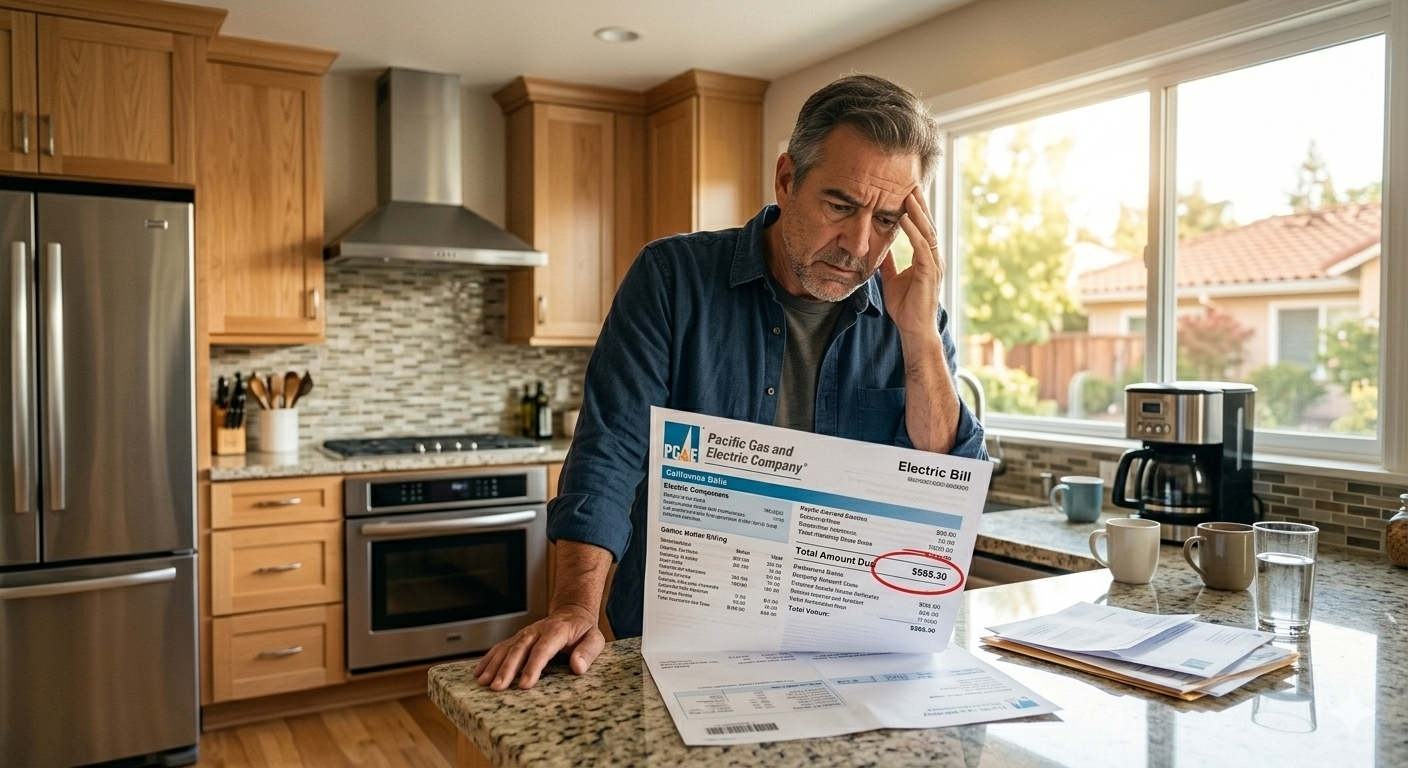
If your PG&E bill has nearly doubled in the last four years and you can't figure out why — you're not imagining it. PG&E rates have increased over 40% since 2022, with more increases already approved through 2026 and beyond. This guide explains exactly what's driving your bill, what California homeowners are doing to fight back, and which solutions actually move the needle versus which ones barely make a dent.
Free · No Credit Pull · 60 Seconds
Find Out How Much You Could Cut Your PG&E Bill
Every home is different. Tell us your bill and zip code — we'll show you exactly what's possible with solar, batteries, and smart home upgrades. No obligation.
See My Options →
🔒 No spam · No credit pull · Free · 1-hour local follow-up
PG&E Rate History — What Has Actually Happened to Your Bill
PG&E is not shy about rate increases. The California Public Utilities Commission (CPUC) has approved a series of general rate cases, wildfire mitigation surcharges, infrastructure upgrades, and grid modernization charges — all of which land on your bill as line items that barely get a headline but add up to real money.
Here's what's happened to the average PG&E residential electricity rate since 2020:
2020
Baseline residential rate (E-1 tariff average)
~24¢/kWh
2021
First post-Camp Fire infrastructure surcharge approved
~27¢/kWh
2022
Wildfire mitigation + grid hardening charges added
~30¢/kWh
2023
General Rate Case increase + 13% hike approved by CPUC
~36¢/kWh
2024
Additional distribution upgrade surcharges take effect
~41¢/kWh
2025–26
Further GRC increases + fixed charge restructuring ongoing
45–52¢/kWh
For a home using 800 kWh per month — a modest California household — that's the difference between a $192 monthly bill in 2020 and a $360–$416 monthly bill today. The usage didn't change. The rate did.
The real comparison: The average PG&E residential customer now pays more per kilowatt-hour than homeowners in Germany, Japan, or the United Kingdom — countries with reputations for expensive electricity. California's grid is among the most expensive in the developed world for residential customers, and it's not close.
What's Actually on Your PG&E Bill — And Why Each Charge Keeps Growing
Most California homeowners look at their bill total and never dig into the line items. That's a mistake — because understanding what's driving the charges tells you which solutions actually address the problem and which ones are window dressing.
Approximate breakdown — average PG&E residential bill 2026
Energy generation charge (actual electricity you use)
~35%
Distribution charges (local power lines, transformers, meters)
~28%
Wildfire mitigation surcharges (WMPF, DWR, FHPWC)
~15%
Transmission charges (high-voltage grid infrastructure)
~12%
Taxes, surcharges, public purpose programs
~10%
Source: PG&E rate schedule filings. Percentages are approximate and vary by usage level and rate plan. Distribution and wildfire charges have increased the fastest since 2020.
Here's the critical insight hidden in that breakdown: only 35% of your bill is for the actual electricity you use. The other 65% is infrastructure, wildfire mitigation, and fixed charges that you pay regardless of how much power you consume. That's why energy efficiency alone — turning off lights, shorter showers, programmable thermostats — can only reduce your bill so much. You can cut your usage in half and still pay 65% of your current bill.
This is exactly why solar + battery has become the dominant strategy for California homeowners serious about escaping PG&E's rate trajectory. When your solar system generates the power you use, you eliminate the generation charge and dramatically reduce the distribution charge through self-consumption. You can't eliminate the wildfire surcharges entirely — those are fixed — but you can reduce the variable portion of your bill by 70–85% with the right system design.
NEM 3.0 — What Changed in 2023 and Why It Matters in 2026
In April 2023, the CPUC implemented NEM 3.0 (Net Energy Metering 3.0) for new solar customers on PG&E, SCE, and SDG&E. If you've heard that "solar isn't worth it anymore in California" — NEM 3.0 is why people say that. Here's the reality.
NEM 2.0 vs NEM 3.0 — What Actually Changed
NEM 2.0 (before April 2023)
Excess solar exported to the grid was credited at near-retail rates — roughly 30–35¢/kWh. This made solar-only systems highly profitable. You could export midday solar and get paid almost what you'd pay to buy it back at night.
NEM 3.0 (current — all new installs)
Export credits dropped to 2–8¢/kWh for most peak solar hours. Midday surplus exported to the grid is worth a fraction of what you'd pay to buy it back at 6pm during peak TOU pricing. Solar-only economics weakened. Solar + battery economics strengthened significantly.
The practical effect: solar panels alone, without a battery, are less effective under NEM 3.0. The system still saves money, but the payback period extends and the total savings are lower if you're exporting significant surplus. The solution — and this is why every serious California solar company has pivoted to solar + battery packages — is to store that midday surplus in a home battery and discharge it during peak evening hours (4–9pm) when PG&E's TOU rates are highest. You use your own solar-generated power instead of buying expensive grid power. The battery turns a NEM 3.0 disadvantage into a net positive.
The NEM 3.0 opportunity: A correctly sized solar + battery system under NEM 3.0 can actually outperform an equivalently sized NEM 2.0 solar-only system in real-world savings — because the battery eliminates the evening peak grid draw that costs 45–52¢/kWh. The math works. It just requires the battery.
See home battery options →
What California Homeowners Are Actually Doing to Lower Their PG&E Bills
There's a spectrum of responses — from small smart home upgrades that chip away at the edges, to solar + battery systems that fundamentally change the relationship with PG&E. Here's an honest look at each approach, what it costs, and what it actually saves.
Option 1
Smart thermostats + energy monitors
The cheapest entry point. Smart thermostats can reduce HVAC usage by 10–23% according to Energy Star. Energy monitors show you exactly which appliances are burning the most power so you can target the real offenders.
Save: $50–$200/yr · Cost: $30–$340
Option 2
Time-of-use rate optimization
Shifting laundry, dishwasher, and EV charging to off-peak hours (before 4pm and after 9pm) can meaningfully reduce your bill under PG&E's TOU-C and TOU-D rate plans without spending anything.
Save: $100–$400/yr · Cost: $0
Option 3 — Most Popular 2026
Solar + battery (prepaid lease or PPA)
The full solution. Eliminates 70–85% of your PG&E bill. Battery handles peak evening hours under NEM 3.0. $0 upfront with a PPA or 30% off with a prepaid lease. 8–9 year payback on owned systems.
Save: $150–$400/mo · Cost: $0 down or 30% off
Option 4
Battery-only (no solar)
LightReach offers a $0-down battery-only lease. Stores cheap off-peak power and discharges during expensive TOU peak hours. Backup protection included. Works with existing solar or standalone.
Save: $50–$200/yr · Cost: $0 down lease
PG&E Territory · California Homeowners
See What Solar + Battery Saves on Your Specific Bill
We calculate real numbers based on your actual PG&E bill, zip code, and roof. No credit pull required to see your estimate. Takes 60 seconds.
Get My Free Estimate →
🔒 No spam · No credit pull · Free · 1-hour local follow-up
Step 1 — Know What's Using Power: Home Energy Monitors
Before you invest in any solution, you need to know where your power is actually going. Most homeowners are shocked when they plug an energy monitor into their circuit panel and see that their pool pump, old refrigerator, or always-on gaming PC is responsible for 30–40% of their monthly bill.
A whole-home energy monitor gives you real-time visibility into every circuit in your house — not just the total usage on your utility bill, but which specific appliances are drawing power and when. This data is invaluable for two reasons: it tells you which appliances to replace first, and it gives you a pre-solar baseline so you can correctly size your system.
Affiliate disclosure: The products below contain Amazon affiliate links. Solar With Watts earns a small commission on qualifying purchases at no additional cost to you. We only recommend products our team has researched and verified as relevant for California homeowners managing high PG&E bills.
Best Overall
Emporia Vue 3 Home Energy Monitor
~$149 · Amazon
The Emporia Vue 3 is the most comprehensive whole-home energy monitor available for under $200. It clips directly onto your main circuit breaker panel and monitors up to 16 individual circuits simultaneously — so you can see exactly how much your AC, EV charger, water heater, and major appliances each draw in real time. The app breaks down your usage by hour, day, and month and estimates your bill before it arrives. For PG&E homeowners under TOU rates, the Emporia Vue's time-of-use cost tracking is the most useful feature — it shows you the dollar cost of running your dryer at 6pm versus 10pm, making TOU optimization effortless. Works with solar systems to show net consumption vs. production.
16-circuit monitoring
Real-time app
TOU cost tracking
Solar compatible
Alexa integration
Kasa KP125M Smart Plug with Energy Monitoring (4-pack)
~$30 for 4-pack · Amazon
If you're not ready to install a panel-level monitor, the Kasa KP125M smart plug is the fastest way to identify which individual appliances are costing you the most. Plug it in between any device and the outlet — refrigerator, space heater, gaming setup, dehumidifier — and the Kasa app shows you real-time wattage and estimated monthly cost. The KP125M is Matter-certified, meaning it works natively with Apple HomeKit, Google Home, Alexa, and SmartThings without a separate hub. The 4-pack gives you enough to monitor your four biggest suspected energy hogs simultaneously. At $30 for four plugs, this is the lowest-cost way to start understanding your home's energy footprint before making any larger investment.
Matter certified
Per-device monitoring
Works with Alexa/Google/HomeKit
No hub required
4-pack value
Step 2 — Eliminate Wasted HVAC Costs: Smart Thermostats
Heating and cooling account for roughly 40–50% of the average California home's electricity usage. In the Central Valley and inland PG&E territory — Fresno, Stockton, Sacramento, Folsom, Elk Grove — summer AC usage can push monthly bills to $400–$600 without solar. A smart thermostat won't replace solar, but it's the highest-ROI smart home upgrade you can make today.
The reason smart thermostats outperform programmable thermostats isn't just scheduling — it's geofencing, occupancy detection, and learned behavior. A smart thermostat knows when you leave for work and stops cooling an empty house. It knows when you're 20 minutes from home and starts pre-cooling before you arrive. It knows your weekend schedule differs from your weekday schedule without you programming anything.
For PG&E TOU customers, smart thermostats have one additional superpower: pre-cooling. The thermostat automatically cools your home to 72°F before 4pm — when power is cheap — then lets the temperature drift up to 76°F naturally during the expensive 4–9pm TOU peak window. You stay comfortable, you buy less expensive peak power, and PG&E charges you less. This strategy alone can save $15–$40/month during summer without any discomfort.
Top Pick
Google Nest Learning Thermostat (4th Gen)
~$279 · Amazon
The Nest Learning Thermostat 4th Gen is the most intuitive smart thermostat on the market and the clear choice for most PG&E homeowners. It learns your schedule within a week — you don't program it, you just use it. It figures out when you wake up, when you leave, when you come home, and when you go to bed, then builds an automatic schedule around your real patterns. The 4th Gen adds Matter compatibility for future-proof smart home integration and a Nest Temperature Sensor in the box for more accurate room-level readings. PG&E participates in demand response programs that can pay you small credits for allowing brief temperature adjustments during grid stress events — the Nest integrates with PG&E's Rush Hour Rewards program automatically.
Self-learning
Matter compatible
PG&E Rush Hour Rewards
Geofencing
Sensor included
Works with Alexa/Google
Ecobee Smart Thermostat Premium
~$249 · Amazon
The Ecobee Premium is the best choice for larger homes or anyone who wants room-level temperature precision. The included SmartSensor detects occupancy in specific rooms and prioritizes comfort where people actually are — not just at the thermostat location. The built-in Alexa and air quality monitor are unique to Ecobee at this price point. For homes with multiple zones or significant temperature variation between rooms, the Ecobee's sensor ecosystem is unmatched. It also integrates with PG&E demand response programs and has the most comprehensive energy reporting of any thermostat in this price range, showing you daily kWh savings versus a standard setback schedule.
Room sensors included
Built-in Alexa
Air quality monitor
Works with all ecosystems
Demand response ready
Amazon Smart Thermostat
~$79 · Amazon
If you're Alexa-first and want a capable smart thermostat at a fraction of the cost, the Amazon Smart Thermostat delivers the essentials without the premium price. It's Energy Star certified, works seamlessly with Alexa routines (including "Alexa, I'm leaving" to trigger energy-saving mode), and handles basic scheduling and geofencing reliably. It won't self-learn like the Nest or offer room sensors like the Ecobee, but for a single-zone home where you want simple Alexa integration and basic scheduling, it's the most cost-effective entry point. Pair it with a Kasa energy monitoring plug on your HVAC unit to track actual AC energy draw.
Energy Star certified
Alexa native
Geofencing
C-wire adapter included
Budget pick
Smart Home vs Solar — Honest Comparison of What Each Actually Does
Smart home upgrades are real. They save real money. But it's worth being honest about their ceiling versus what solar + battery actually delivers.
| Solution |
Upfront cost |
Monthly savings |
Addresses rate increases? |
Payback period |
| Smart thermostat (Nest/Ecobee) |
$79–$279 |
$8–$25/mo |
Partially |
12–24 months |
| Home energy monitor (Emporia) |
$149 |
$10–$40/mo (behavior change) |
No |
4–15 months |
| TOU rate optimization (no cost) |
$0 |
$15–$50/mo |
No |
Immediate |
| Solar + battery (prepaid lease) |
30% off gross (financed) |
$150–$400/mo |
Yes — locks in your rate |
8–9 years (owned) |
| $0-down solar PPA |
$0 |
$80–$250/mo |
Yes — fixed PPA rate |
N/A — never own |
| Battery-only lease (LightReach) |
$0 |
$30–$120/mo |
Partially |
N/A — leased |
The key column is "Addresses rate increases?" Smart home upgrades reduce how much you use — but the rate you pay per kWh keeps climbing regardless. A $250/month bill with a smart thermostat becomes a $280/month bill two years later when PG&E raises rates again. Solar + battery locks in your effective rate because you're generating your own power. The utility rate increase becomes someone else's problem.
🔋
$0 Down · PG&E Territory
LightReach Solar + Battery — The Only PPA That Includes Battery Storage
For NEM 3.0 PG&E customers, LightReach's solar + battery PPA is the only $0-down product that addresses both daytime generation and evening peak draw in a single agreement.
See LightReach options →
Step 3 — The Real Solution: Solar + Battery for PG&E Homeowners
Smart thermostats and energy monitors are the right starting point — particularly if you're not ready to commit to solar yet or if your home needs a roof replacement before solar is viable. But they address the edges of your bill, not the core. The average PG&E homeowner spending $280–$400/month saves $15–$60/month from smart home upgrades. That's real money. It's also 15–20% of the problem.
Solar + battery addresses the other 80%. Here's why it works specifically for PG&E customers in 2026:
1
Your panels generate free power during peak production hours (8am–4pm)
During the hours when California sun is strongest, your panels produce more power than your home typically uses. Under NEM 3.0, exporting this surplus isn't as lucrative as it was before — which is exactly why the battery matters.
2
Your battery stores the surplus instead of exporting it cheap
Rather than sending midday solar to the grid at 2–8¢/kWh, the Powerwall or SolarEdge battery stores it. A fully charged 13.5 kWh Powerwall holds enough energy to power the average California home for 8–12 hours.
3
Your battery discharges during the 4–9pm TOU peak window
Instead of buying grid power at 45–52¢/kWh during PG&E's most expensive hours, you use your stored solar. The battery discharge eliminates the most expensive portion of your daily grid draw — the evening peak that drives the bulk of your bill.
4
You buy a small amount of cheap off-peak power overnight if needed
Any remaining overnight grid draw happens during PG&E's cheapest off-peak hours (after 9pm and before 4pm). You're buying the least expensive grid power available — typically 18–25¢/kWh versus 45–52¢/kWh at peak. Your net monthly grid bill drops to $15–$40 in most cases.
What this looks like on a real bill: A Sacramento-area PG&E homeowner with a $380/month bill installs solar + 2 Powerwalls via prepaid lease. After installation, their effective monthly cost — loan payment minus eliminated PG&E bill — is approximately $180–$210/month. Net savings from day one: $170–$200/month. No rate exposure. No PSPS vulnerability. Whole-home backup included.
☀️
$0 Down · All PG&E Territory
California Solar PPA — LightReach, GoodLeap & EnFin Compared
A complete comparison of every $0-down California solar PPA provider we work with — rates, terms, battery inclusion, and which option fits your specific utility bill and credit profile.
Compare all PPA options →
What About SMUD Customers? Your Situation Is Different — And Better
If you're served by SMUD rather than PG&E, your baseline electricity rate is significantly lower — roughly 16–22¢/kWh versus PG&E's 45–52¢/kWh. The pain is less acute, but the incentive stack available to you is the strongest in California and makes solar + battery financially compelling even at lower rates.
SMUD homeowners have access to three simultaneous incentive programs that PG&E customers simply don't have: the 30% prepaid lease discount, the My Energy Optimizer Partner+ battery rebate of up to $5,400 per Powerwall (cap $10,000/household), and $440/year per Tesla Powerwall in ongoing VPP payments. Three programs stacking simultaneously, none requiring a personal tax credit.
🔋
SMUD Territory · Sacramento
SMUD Battery Rebate 2026 — Up to $5,400/Powerwall + VPP Payments
Sacramento County SMUD homeowners have the strongest solar + battery incentive stack in California. Here's exactly how the three programs stack and what the numbers look like for a typical home.
See the full SMUD incentive stack →
Your 2026 Action Plan — In Order of Priority
Not everyone is ready to go solar today. Here's the right sequence based on where you are right now:
1
This week — Audit your bill and shift TOU usage (free)
Log into PG&E's website and check which rate plan you're on. If you're on the default E-1 tiered plan, request a comparison to TOU-C or TOU-D. Shifting laundry, dishwasher, and EV charging to before 4pm or after 9pm is immediate and free savings.
2
This month — Install an energy monitor to find hidden waste
The Emporia Vue 3 ($149) is the fastest way to identify which appliances are driving your bill. Most homeowners find 1–2 devices responsible for 20–30% of their usage — old refrigerators, pool pumps, space heaters, and always-on electronics are the usual suspects.
3
This month — Upgrade your thermostat
The Google Nest (4th Gen) ($279) or Ecobee Premium ($249) pays back in under 2 years and starts saving immediately. The pre-cooling strategy alone — cooling before 4pm so the AC rarely runs during TOU peak — can save $20–$40/month in summer without discomfort.
4
Now — Get a solar + battery estimate
Getting a free estimate takes 60 seconds and requires no credit pull. You'll see real numbers — system size, monthly payment, estimated PG&E bill after solar, and payback period — based on your actual bill and roof. Most California homeowners are surprised by how affordable the numbers are after the 30% prepaid lease discount. There's no obligation and no pressure to decide anything.
Common Questions — PG&E Bills & California Energy Costs 2026
Why is my PG&E bill so high in 2026? +
PG&E rates have increased over 40% since 2022 due to a combination of wildfire mitigation surcharges, infrastructure modernization costs approved through the General Rate Case, distribution system upgrades, and transmission charges. Only about 35% of your bill is for the actual electricity you use — the remaining 65% is fixed infrastructure and surcharge charges that grow with each CPUC rate approval regardless of your usage. The most recent increases were approved through PG&E's 2023 General Rate Case, with further increases possible through 2026.
What is the fastest way to lower my PG&E bill? +
The fastest no-cost action is switching to a Time-of-Use rate plan (TOU-C or TOU-D) and shifting high-draw appliances — laundry, dishwasher, EV charging — to before 4pm or after 9pm. This can save $15–$50/month immediately. Adding a smart thermostat with pre-cooling strategy adds another $15–$40/month in summer. The largest reduction by far — 70–85% of your bill — comes from solar + battery, which addresses both the usage charge and rate exposure simultaneously.
Are PG&E rates going to keep increasing? +
Yes — PG&E has filed for continued rate increases through its next General Rate Case and has significant infrastructure investment requirements approved by the CPUC through the 2020s. Wildfire mitigation costs are legally mandated and ongoing. The CPUC has historically approved the majority of PG&E's rate increase requests. Most industry analysts project California residential electricity rates to continue rising 5–10% annually. This is the primary reason solar + battery has a meaningful financial advantage over smart home upgrades alone — it locks in your effective energy cost rather than continuing to expose you to annual rate increases.
Is solar still worth it in California under NEM 3.0? +
Yes — but the calculus has shifted. Solar-only systems without a battery are less profitable under NEM 3.0 because export credits dropped from near-retail to 2–8¢/kWh. Solar + battery systems are the correct configuration under NEM 3.0, and in many cases perform better financially than equivalent NEM 2.0 solar-only systems did — because the battery eliminates peak evening grid draw at 45–52¢/kWh rather than exporting cheap surplus. The 30% prepaid lease discount and $0-down PPA options make entry accessible without the tax credit. An 8–9 year payback on an owned solar + battery system remains a strong return given that PG&E rates continue rising on the remaining 10–15 years of system life after payback.
What is a PG&E TOU rate plan and should I switch? +
A Time-of-Use (TOU) rate plan charges different prices per kWh depending on the time of day. PG&E's TOU plans charge the most during peak hours (4–9pm) and the least during off-peak hours (before 4pm and after 9pm on weekdays). If you can shift significant loads — laundry, dishwasher, EV charging, pool pump — to off-peak hours, a TOU plan typically saves $30–$100/month compared to the tiered E-1 default plan. You can request a free comparison analysis from PG&E's website showing projected savings based on your actual usage before switching. If you're planning to add solar, you'll automatically move to NEMTOU (now called the Solar and Storage Rate) after interconnection.
Does a smart thermostat really save money on a PG&E bill? +
Yes — but the savings depend on how much your HVAC is currently contributing to your bill and how well you implement the thermostat's features. Energy Star estimates 10–23% savings on heating and cooling costs, which translates to roughly $8–$40/month for most California homes where HVAC is the dominant load. The biggest leverage for PG&E TOU customers is the pre-cooling strategy: the thermostat automatically cools your home before 4pm and lets temperature drift during peak hours, reducing peak grid draw without discomfort. A smart thermostat is a high-ROI upgrade that pays back in 12–24 months, but it's a complement to solar rather than a replacement — it reduces how much energy you need to generate, which can mean a smaller (cheaper) solar system.
What solar options are available for PG&E customers with no money down? +
PG&E territory homeowners have three $0-down solar options: (1)
LightReach PPA — the only PPA that includes battery storage under the same agreement, critical for NEM 3.0 savings. (2)
GoodLeap PPA — established $0-down solar from one of California's most recognized PPA providers. (3)
EnFin PPA — straightforward $0-down terms with competitive rates. We also offer a
prepaid lease — not $0 down but 30% off upfront with financing available through Credit Human or Wheelhouse — which gives you ownership after 5 years and typically delivers stronger long-term savings than a PPA. We compare all four options side by side with real numbers at no obligation.
Get your free estimate →
PG&E Territory · All of Northern & Central California
Stop Paying PG&E More Every Year — Start With a Free Estimate
60 seconds. No credit pull. Real numbers based on your actual bill and roof. We show you solar, battery, and smart home options side by side — and we never pressure you to decide anything on the first call.
Get My Free PG&E Savings Estimate →
🔒 No spam · No credit pull · Free · CSLB #1065773 · Serving PG&E territory throughout Northern & Central California
About the author: Ed Watts is the founder of Solar With Watts, a California solar sales and home energy company serving PG&E, SMUD, SCE, Pioneer Community Energy, and SDG&E territories in Northern and Central California. He has 10 years of solar sales experience with 400+ closed deals across residential solar and battery storage.
Rate figures shown are based on published PG&E tariff schedules and represent approximate averages. Individual rates vary by usage tier, rate plan, and location. Smart thermostat savings estimates based on Energy Star certified data. Solar savings estimates are illustrative and based on typical system designs — actual savings depend on system size, usage, roof orientation, and financing structure. Affiliate disclosure: This post contains Amazon affiliate links. Solar With Watts earns a commission on qualifying purchases at no additional cost to you.