Ready to price out a roof + solar bundle?
Get a free assessment for your specific home — roof size, condition, solar savings, and financing options in one conversation. Owens Corning & GAF shingles. PG&E, SCE & SMUD territories.
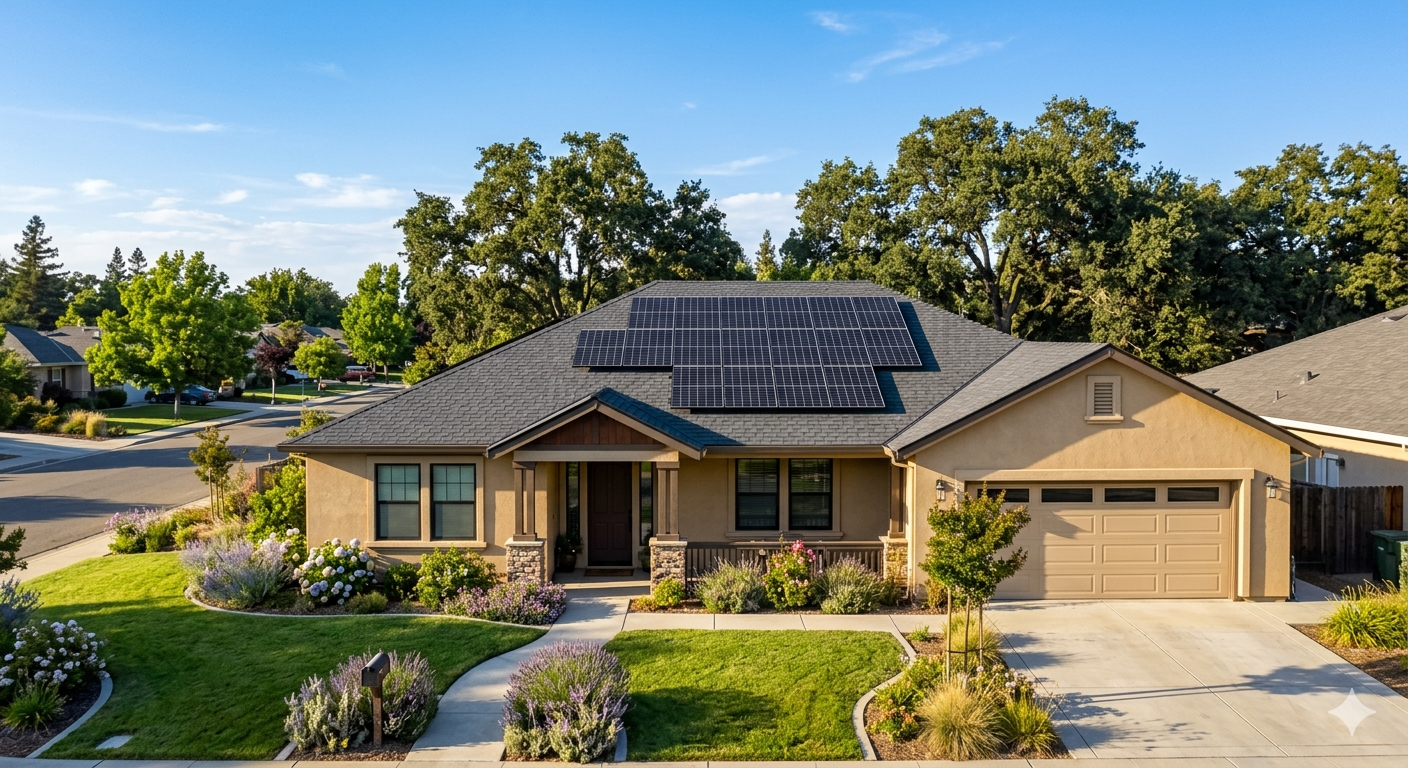
Most California homeowners don't realize their roof could cost them an extra $5,000 or more after going solar — not from the panels, but from having to remove and reinstall them when an aging roof finally gives out. Find out if your roof is ready, and how bundling both projects together with the right financing could save you thousands.
The $5,000 mistake most solar customers don't see coming: Installing solar on an aging roof means paying to remove and reinstall every panel when the roof gives out — at roughly $255–$275 per panel. A 20-panel system adds up fast. This guide shows you how to avoid it entirely.
Solar panels are designed to last 25 to 30 years. Your roof needs to last just as long — ideally without requiring replacement while panels are sitting on top of it. That alignment is the single most important factor most homeowners overlook when going solar.
When a roofing contractor installs solar panels, they're drilling through your roof deck, attaching mounting hardware, running conduit, and sealing penetrations. The work is designed to be permanent for the life of the solar system. What it is not designed for is being undone and redone partway through — which is exactly what happens when an aging roof fails under an active solar array.
According to ConsumerAffairs, removing and reinstalling a rooftop solar array costs approximately $255 to $275 per panel — not including the cost of lost energy production while your system is offline. On a 20-panel system, that's $5,100 to $5,500 in surprise costs on top of whatever your new roof costs.
The rule of thumb: If your roof is more than 10 years old and you're planning to go solar, get a professional roof inspection first. If it has less than 15 years of life remaining, replacing it before — or bundled with — your solar installation is almost always the smarter financial move.
Not every older roof needs immediate replacement. The condition of your roof matters more than its age alone. Here's a practical checklist to evaluate where your roof stands before committing to solar.
There are three paths a California homeowner can take when they need both a new roof and solar. Each has a different cost profile, risk level, and long-term outcome. Here's how they compare honestly.
| Scenario | Upfront Cost | Risk Level | Long-Term Cost | Best For |
|---|---|---|---|---|
| Solar on old roof | Lowest | High | $5K–$8K+ in panel removal/reinstall costs when roof fails | Roofs with 15+ years of verified life remaining only |
| Roof first, solar later | Medium — two separate projects | Medium | Two mobilizations, two permit pulls, higher total labor | Homeowners not yet ready to commit to solar |
| Bundle roof + solar together | Higher upfront — one combined project | Lowest | Best total value — one mobilization, aligned lifespans, single financing | Most California homeowners with aging roofs |
The bundled approach works particularly well for Northern and Central California homeowners because the savings on solar energy costs offset the combined project payment — meaning the total monthly cost of a roof + solar bundle is often lower than your current roof-only mortgage payment plus your current utility bill combined.
Important: You cannot replace a roof while solar panels are installed on it. The panels must come down first. This means any homeowner who installs solar on a roof with less than 15 years of remaining life is guaranteed to face a costly removal and reinstall at some point during the 25-year life of their solar system.
Get a free assessment for your specific home — roof size, condition, solar savings, and financing options in one conversation. Owens Corning & GAF shingles. PG&E, SCE & SMUD territories.
Both Owens Corning and GAF are premium shingle manufacturers and the two most widely specified brands for solar-ready roof replacements in Northern California. Our EPC partner Sequoia Roofing & Construction (CSLB #1064775) installs both. Here's how they compare for homeowners planning to add solar.
| Feature | Owens Corning | GAF |
|---|---|---|
| Warranty | Limited Lifetime (Duration Series) | Limited Lifetime (Timberline HDZ) |
| Wind resistance | Up to 130 mph | Up to 130 mph |
| Fire rating | Class A | Class A |
| Solar compatibility | Excellent | Excellent |
| Cool roof options | Yes — Cool Series available | Yes — Reflector Series available |
| California fire zone approved | Yes | Yes |
| Best for | El Dorado Hills, Folsom, Elk Grove foothill homes | Sacramento metro, Fresno, Bakersfield tract homes |
Both brands meet California's Title 24 energy code requirements and are approved for use in high fire-risk zones (VHFHSZ). Either is an excellent choice for a solar-ready roof replacement in our service area. Your Sequoia project manager will recommend the right product based on your roof pitch, neighborhood aesthetic, and HOA requirements if applicable.
Roof replacement costs in California vary by size, material, pitch, and tear-off complexity. Here are realistic ranges for the Sacramento, Fresno, and Bakersfield markets based on current labor and material pricing.
| Home Size | Roof Square Footage | Estimated Cost (Owens Corning/GAF) | With Solar Bundle |
|---|---|---|---|
| 1,200–1,600 sq ft home | 1,400–1,800 sq ft roof | $10,000–$14,000 | One combined project — single financing |
| 1,600–2,200 sq ft home | 1,800–2,600 sq ft roof | $13,000–$19,000 | One combined project — single financing |
| 2,200–3,000 sq ft home | 2,600–3,600 sq ft roof | $18,000–$26,000 | One combined project — single financing |
Estimates based on current Northern/Central California labor and material rates for architectural shingle replacement including tear-off and disposal. Complex rooflines, steep pitches, and high-access requirements may increase cost. Request a free assessment for your specific home.
Yes — and this is one of the most underutilized advantages of working with a company that handles both roofing and solar. When you bundle both projects, you have access to financing options that make the combined monthly payment far more manageable than most homeowners expect.
Administered by CAEATFA. Available through participating credit unions. Verify current rates at gogreenfinancing.com.
⚠️ PACE creates a lien on your property repaid through property taxes. Must be disclosed to buyers if you sell. Review all terms carefully. homerunfinancing.com
Solar savings are passed through by the leasing company under the federal 48E commercial tax credit — homeowner keeps the 30% discount without needing tax liability.
The most common bundle for our customers: Prepaid Solar Lease (solar portion financed through Credit Human unsecured) + GoGreen Home Financing (for the roofing portion) = one combined monthly payment that is typically less than their current PG&E, SCE, or SMUD bill plus mortgage combined.
This is one of the most common questions homeowners ask — and the answer requires a clear distinction between two different tax structures.
The federal residential ITC (25D) expired December 31, 2025 and is no longer available for homeowner-purchased solar systems. However, solar purchased through a lease or PPA still qualifies under the federal 48E commercial credit through 2027 — the leasing company captures it and passes the 30% savings to you upfront. No tax liability required on your end.
As for the roofing portion: the IRS has consistently ruled that traditional roofing materials — shingles, underlayment, decking — do not qualify for energy tax credits even when the roof is replaced as part of a solar project. The solar hardware itself (panels, inverters, mounting hardware) qualifies under the lease structure. The roof replacement does not.
This is exactly why financing the roofing portion through GoGreen Home or Home Run PACE makes strategic sense — you get the solar savings through the lease structure and finance the roof through a state-backed low-rate program.
Get a free roof assessment and solar savings estimate — one project, one contractor, one payment. Serving PG&E, SCE & SMUD territories.
One project. One contractor. One monthly payment that's typically lower than your current roof-only mortgage plus your utility bill combined. We handle the roofing, solar, permitting, and utility paperwork across Northern and Central California.
Free · No credit check · No obligation · (209) 216-8180
30% off solar upfront — no tax credit required. California homeowners who bundle roofing + solar can lock in 30% off the solar system cost through our prepaid lease program. The savings pass through from the leasing company — no tax liability needed on your end. Learn how the prepaid lease works →
The most common questions California homeowners ask before bundling a roof replacement with solar.
Not always — but you should if your roof is more than 10–15 years old or showing signs of wear. Solar panels are designed to last 25–30 years, and if your roof fails while panels are installed, you'll pay $255–$275 per panel to remove and reinstall them before a new roof can go on. On a 20-panel system that's $5,100–$5,500 in avoidable costs.
If your roof has at least 15 years of verified life remaining, proceeding with solar is generally fine. If it doesn't, bundling a roof replacement with your solar installation is almost always the smarter financial decision.
For a typical Northern or Central California home, roof replacement with Owens Corning or GAF architectural shingles ranges from $10,000 to $26,000 depending on home size, roof complexity, and pitch. A 1,600–2,200 sq ft home typically falls in the $13,000–$19,000 range.
When bundled with solar, both projects are completed under a single mobilization — saving on labor, permitting, and coordination costs compared to doing them separately. Financing options including GoGreen Home and Home Run PACE can spread the combined cost over 15–30 years.
Yes — and this is one of the most underutilized advantages of working with a company that handles both roofing and solar. California homeowners have three strong financing paths for a bundled project:
GoGreen Home Financing — a State of California program offering rates from 3.58%–9.48% APR with terms up to 20 years for solar-inclusive projects. No property lien. Solar Savings Direct is an enrolled GoGreen contractor.
Home Run PACE — approval based on home equity rather than credit score. Terms up to 30 years. Repaid through your property tax bill. Covers both roofing and solar. Available in 360+ California jurisdictions. Note: PACE creates a lien on your property.
Prepaid Solar Lease + Unsecured Loan — use the 30% prepaid lease discount on the solar portion and finance the roof separately through Credit Human (unsecured). No tax liability required.
When your roof eventually fails, every solar panel must be removed before a new roof can be installed — then reinstalled once the roofing work is complete. This process costs approximately $255–$275 per panel in labor, plus you lose energy production during the downtime.
Beyond the cost, there's a permitting consideration: California roofing contractors cannot install a new roof with panels in place, and solar companies won't reinstall on a roof that hasn't been inspected and approved. The process creates delays, added expense, and coordination headaches that are entirely avoidable by addressing the roof before or alongside your solar installation.
No. The IRS consistently rules that traditional roofing materials — shingles, underlayment, and decking — do not qualify for energy tax credits, even when replaced as part of a solar project. Only the solar hardware itself (panels, inverters, mounting hardware) qualifies.
It's also important to note that the federal residential ITC (25D) expired December 31, 2025 and is no longer available for homeowner-purchased systems. However, solar installed through a lease or PPA still qualifies under the federal 48E commercial credit through 2027 — the leasing company captures it and passes the 30% savings to you upfront with no tax liability required on your end.
Home Run PACE is an excellent option for California homeowners who have limited credit history or a lower FICO score, because approval is based on home equity and mortgage payment history — not your credit score. It covers both roofing and solar under one financing agreement, with terms up to 30 years and $0 down.
Important disclosure: PACE financing creates a lien on your property that is repaid through your property tax bill. This must be disclosed to buyers if you sell your home and can complicate mortgage refinancing. Review all terms carefully before proceeding. Home Run PACE operates under strict oversight from California's Department of Financial Protection and Innovation (DFPI).
For most Northern and Central California homeowners, Class A architectural asphalt shingles — specifically Owens Corning Duration Series or GAF Timberline HDZ — are the best combination of performance, solar compatibility, cost, and California fire code compliance.
Both carry limited lifetime warranties, wind resistance up to 130 mph, and Class A fire ratings required in California's high fire-risk zones (VHFHSZ). Metal roofing is the premium long-term pairing for solar — lasting 40–70 years — but carries a higher upfront cost. Tile roofing is compatible with solar but requires specialized mounting hardware and structural load verification.
Yes. Solar With Watts serves homeowners across PG&E, SCE, and SMUD territories throughout Northern and Central California. All three utility customers qualify for the same bundled roof and solar programs, financing options, and 30% off prepaid lease promotion.
SMUD customers have an additional incentive — the SMUD battery rebate of up to $5,400 per Powerwall when adding battery storage alongside solar. PG&E and SCE customers benefit most from pairing solar with battery storage under NEM 3.0, which rewards stored energy exported during peak evening hours. Verify current rates and rebates with your utility before installation.
A typical bundled roof replacement and solar installation in Northern or Central California takes 4–8 weeks from signed agreement to Permission to Operate (PTO) from your utility. The roofing work is completed first — usually 1–2 days for the physical installation — followed by solar mounting, electrical work, inspection, and utility interconnection.
The longest part of the process is typically the utility interconnection timeline, which varies by territory. PG&E interconnection currently runs 4–6 weeks. SMUD is generally faster. Your project manager coordinates all permits, inspections, and utility paperwork as part of the installation.
The fastest way is to take our free 60-second Home Energy Checkup at solarwithwatts.com/energy-checkup. The quiz asks about your roof age and condition, current utility provider, and monthly bill — and gives you an instant read on whether bundling makes sense for your home.
If your home qualifies, a Solar With Watts energy advisor will follow up to walk through your options, confirm roof condition with a professional assessment, and provide a no-obligation estimate for the combined project. We serve homeowners across Sacramento, El Dorado Hills, Folsom, Elk Grove, Stockton, Fresno, Visalia, Bakersfield, and surrounding communities.