
Ground Mount or Roof Solar? Here’s the Real Cost Difference.
Both work well in California. A ground mount typically costs 15 to 25 percent more to build than the same system on your roof. The extra pays for the steel frame, foundations, trenching and a longer wire run. If your electric bill is under $300 per month, a roof system or a battery is usually the better fit.
Is a ground mount or a roof system better for your California home?
It depends on your bill and your land, not on which one looks better. A roof system costs less to build. A ground mount makes sense when your roof can't do the job and your power use is high enough to need a bigger system.
Is ground mount solar worth it in California?
Yes, if your electric bill runs $300 per month or more and you have open, sunny ground. Below that, a roof system or a battery usually saves more for less.
How much more does a ground mount cost than roof solar?
Usually 15 to 25 percent more for the same size system. The extra covers the steel frame, foundations, trenching and a longer wire run to your home.
Who installs ground mount solar near me in California?
Watts Home Services designs ground and roof systems statewide. Installs are done by Mars Home Solutions, a Tesla Certified Installer, for PG&E, SCE, SDG&E and SMUD homes.
Not sure which size you need? Run the free solar estimator first. It sizes the system to your bill, which tells you fast whether a ground mount fits.
How does ground mount solar compare to roof solar?
The panels, inverters and batteries are the same either way. What changes is what holds the panels up, where they sit, and how far the power travels to your home. Here's how the two stack up.
| What matters | Roof mount | Ground mount |
|---|---|---|
| Cost to build | LowerYour roof is already the structure, so there's no frame or foundation to build. | Typically 15 to 25 percent more for the same size system. |
| Smallest system | FlexibleSized to your actual usage, even for smaller bills. | Starts at 8 kW, because the frame, trench and foundations cost about the same at any size. |
| Space needed | None in the yard. You need enough open roof facing south, west or east. | Open, sunny ground roughly the size of a two-car garage for an 8 kW array, plus room around it. |
| Sun and shade | Stuck with your roof's pitch, direction and any nearby trees. | BetterPlaced away from shade and tilted toward the sun for the best production. |
| Roof condition | Your roof needs plenty of life left. An older roof may need replacing first. | No impactYour roof isn't touched, so its age, material and condition don't matter. |
| Wire run | ShortA short run from the roof to your electrical panel. | A trench from the array to your home. The farther away it sits, the more it costs. |
| Cleaning and upkeep | Needs a ladder or a pro to reach the panels. | EasierYou can rinse and check the panels from the ground. |
| Looks | Blends inSits flat on the roof and blends in with the house. | Visible in the yard. Placement and landscaping can soften it. |
| Permits and plans | Standard roof plans with fire-access setbacks on the roof. | Plans add foundation, racking and trench details. Some areas also require cleared space around the array. |
| Battery storage | SameThe battery mounts at your home. | SameThe battery still mounts at your home, not out at the array. |
| Best fit | Most California homes, and most electric bills under $300 per month. | Bills of $300 per month or more, open land, or a roof that can't do the job. |
Code and permit notes: California's residential code exempts ground-mounted arrays from roof fire setbacks, but local rules still apply. For example, the City of El Cajon requires a clear, brush-free area of 10 feet around a ground-mounted array, and Santa Cruz County asks for foundation, racking and trenching details with the plans. Your installer handles these requirements during design and permitting.
Not sure which column you're in? Start with your system size. It decides more than the mounting does.
Size My System →Why does a ground mount cost 15 to 25 percent more to build?
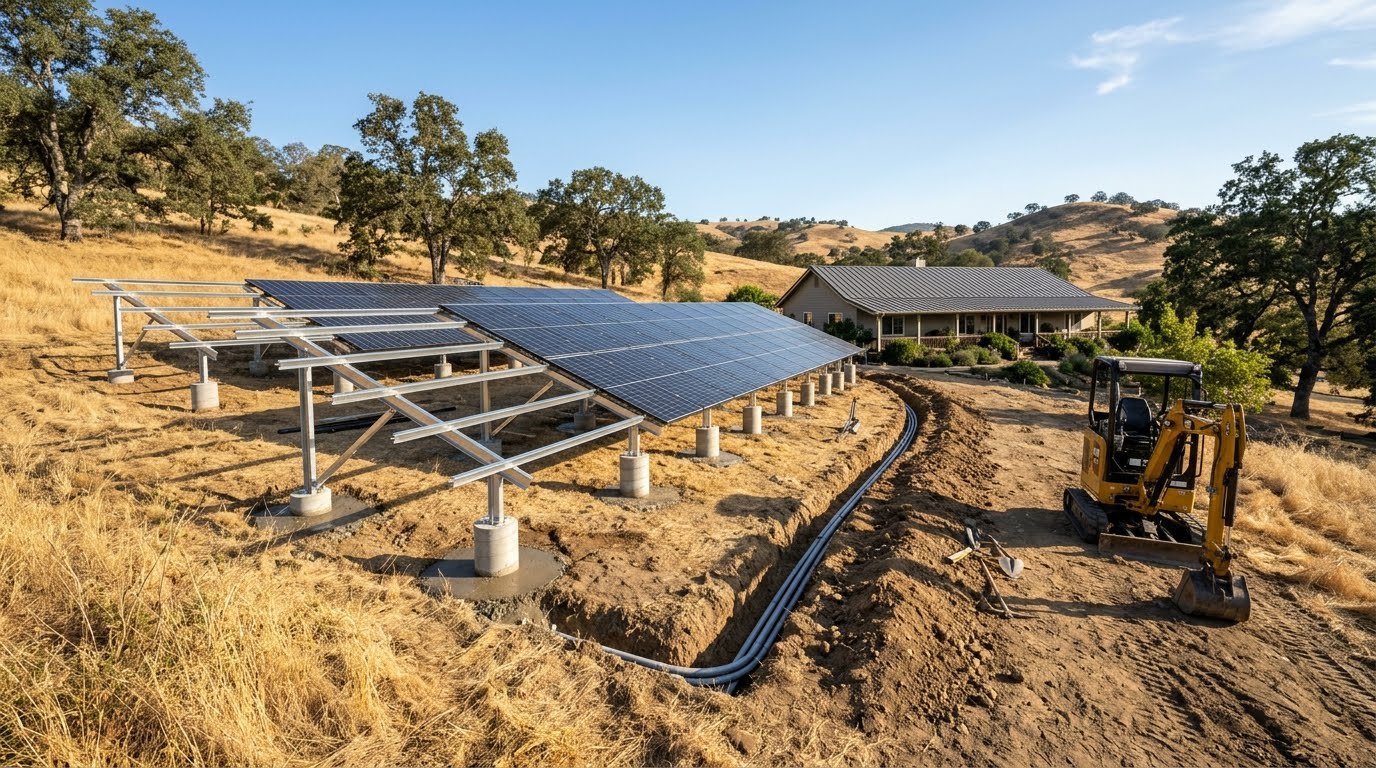
On a roof, the house is already the structure. On the ground, everything that holds the panels up has to be built from scratch. Then the power has to travel underground to your home.
The steel frame
Engineered racking holds the panels at the right angle and is rated for your area's wind. On a roof, that support already exists.
Foundations
Concrete piers or driven posts anchor the frame. Clay, rock or a slope means more digging and engineering. That's settled during design.
Trenching
The wires run underground in conduit from the array to your home. Code sets the burial depth (NEC 300.5), so every foot of distance takes digging.
A longer wire run
The farther the array sits from your electrical panel, the more wire it takes. Long runs also need heavier wire to keep power from being lost along the way.
Space and site prep
The ground may need clearing or leveling, and some areas require a cleared zone around the array. Crews also need room to get equipment in.
Extra plans and permits
Plans add foundation, racking and trench details that a roof system doesn't need, and plan review takes a closer look.
What makes a ground mount cost more, or less?
Every property is different. These are the site details that move the price the most, and they're all checked at the site visit before your system is designed.
| Site detail | Pushes the cost up | Keeps the cost down |
|---|---|---|
| Distance to your panel | ▲ A long run across the property | ▼ Array placed close to the house or electrical panel |
| Soil | ▲ Rock, hardpan or heavy clay | ▼ Soil that's easy to dig |
| Slope | ▲ A steep hillside that needs taller posts or grading | ▼ Flat or gently sloped ground |
| What's in the way | ▲ Crossing a driveway, patio, septic or other buried lines | ▼ A clear, open path to the house |
| Access | ▲ Tight gates or no room for equipment | ▼ Room for a small excavator and material drop-off |
| System size | ▲ A small array, where the fixed costs are spread over fewer panels | ▼ A larger array that spreads the frame and trench cost across more panels |
When does a ground mount make sense for a California home?
A ground mount earns its extra build cost when the roof can't do the job, or when your power use is big enough to need a large system. If any of these sound like your home, it's worth a closer look.
Your roof can't fit enough panels
It's too small, too shaded by trees, or faces the wrong way to make the power you need. On the ground, the array goes where the sun is.
You don't want to touch the roof
An older roof would need replacing first. Or it's brand new tile or metal, and you'd rather keep panels and mounts off it.
You have open, sunny land
Rural and foothill lots often have the room, like many homes we serve around Loomis and El Dorado Hills.
You run big loads
A well pump, a shop or barn, a pool, EV charging, electric heat, or a second home on the property. Big usage needs a big system.
Your bill is $300 per month or more
That's about where your usage fills an 8 kW array or larger. At that size, the frame and trench cost is spread over enough panels to make sense.
It's a farm, ranch or winery
Pumps, cold storage and barns change the math, and so do multiple meters. See our farm and winery solar guide.
Ground mount is usually the better fit when…
- Your bill is $300 per month or more
- The roof is shaded, small, aging, or one you want to leave alone
- You have open land near the house or electrical panel
- You want to keep the panels easy to reach and clean
Roof mount is usually the better fit when…
- Your bill is under $300 per month
- Your roof has good sun and plenty of life left
- The only open ground is far from your electrical panel
- You'd rather keep the yard clear
Still on the fence? Your bill decides most of this. See what size system your home needs, then we'll look at whether the roof or the ground fits it better.
Size My System → Talk It ThroughWill a ground mount pencil out on your electric bill?
Usually only if your electric bill is $300 per month or more. The smallest ground mount we build is 8 kW. Below a $300 bill, that system makes far more power than your home uses, and California pays very little for the extra.
Ground mounts start at 8 kW
The frame, foundations and trench cost about the same at any size, so we don't build them smaller. An 8 kW array makes roughly 11,000 to 12,800 kWh a year in good California sun.
A $300 bill is about 8,000 to 10,000 kWh a year
It depends on your utility. At each one's average home rate, $300 a month is roughly 7,900 kWh a year with SDG&E, 8,900 with PG&E and 10,400 with SCE.
Extra power earns very little
Under California's net billing rules, power you send back is usually credited at far less than what you pay for power. Here's how NEM 3.0 export rates work.
How well does an 8 kW ground mount match your usage?
Find your yearly usage on your bill, or find the monthly bill closest to yours under your utility. Then see whether the smallest ground mount is too much, about right, or room to go bigger.
| Yearly usage | PG&E billabout, per month | SCE billabout, per month | SDG&E billabout, per month | 8 kW array covers | Ground mount fit |
|---|---|---|---|---|---|
| 6,000 kWh | $205 | $170 | $230 | About twice what you use | Poor fit Much of the power goes to the grid for little credit. A roof system sized to you, or a battery, fits better. |
| 9,000 kWh | $305 | $260 | $345 | About 25 to 40 percent more than you use | The starting line Makes sense if your usage is about to grow, like adding an EV, a heat pump or a well pump. |
| 12,000 kWh | $405 | $345 | $455 | About what you use | Good fit The array and your usage line up, and the build cost is spread across a full-size system. |
| 15,000+ kWh | $510+ | $430+ | $570+ | About 75 to 85 percent | Strong fit You'll likely want a larger array, which spreads the frame and trench cost even further. |
How we figured it: monthly bills use each utility's published residential average rate: PG&E 40.6 cents per kWh (March 2026 advisory), SCE 34.5 cents (October 2026 advisory) and SDG&E 45.7 cents (January 2026 rate alert). Bills are rounded, and your rate plan and power provider change them. Production assumes about 1,400 to 1,600 kWh per year for each kW of a well-placed array, which varies by location (check yours with NREL PVWatts). Export credit rules come from the CPUC. SMUD, LADWP and other city utilities charge less per kWh, so the same usage shows up as a smaller bill there. Go by the kWh on your bill. These are estimates, not a quote.
Bill under $300? You still have good options.
Should you add a battery to a ground mount or roof system?
Yes, for most California homes. A battery stores your midday solar and uses it in the evening, when power costs the most. It also keeps your home running when the grid goes down. It works the same whether your panels are on the roof or in the yard.
Your solar works after dark
PG&E, SCE and SDG&E all charge the most from about 4 to 9 PM. A battery covers those hours with your own solar instead of sending it to the grid for a small credit.
Power through shutoffs and storms
Rural and foothill homes, the ones with room for a ground mount, often see the most outages and wildfire shutoffs. See what home backup covers.
No extra trench for the battery
The battery mounts at your home, next to your electrical panel. With a ground mount, the same trench that carries the solar power is all you need.
Your choice of battery
We install the Tesla Powerwall 3, Enphase IQ batteries and SolarEdge. Compare the three side by side.
Discounts that depend on your address
Some areas qualify for an extra energy community discount, and some utilities and local power providers offer battery rebates. We check your address personally.
Battery only works too
Bill under $300, or already have solar? A battery on its own can still cut your peak-hour costs and give you backup, with no new panels.
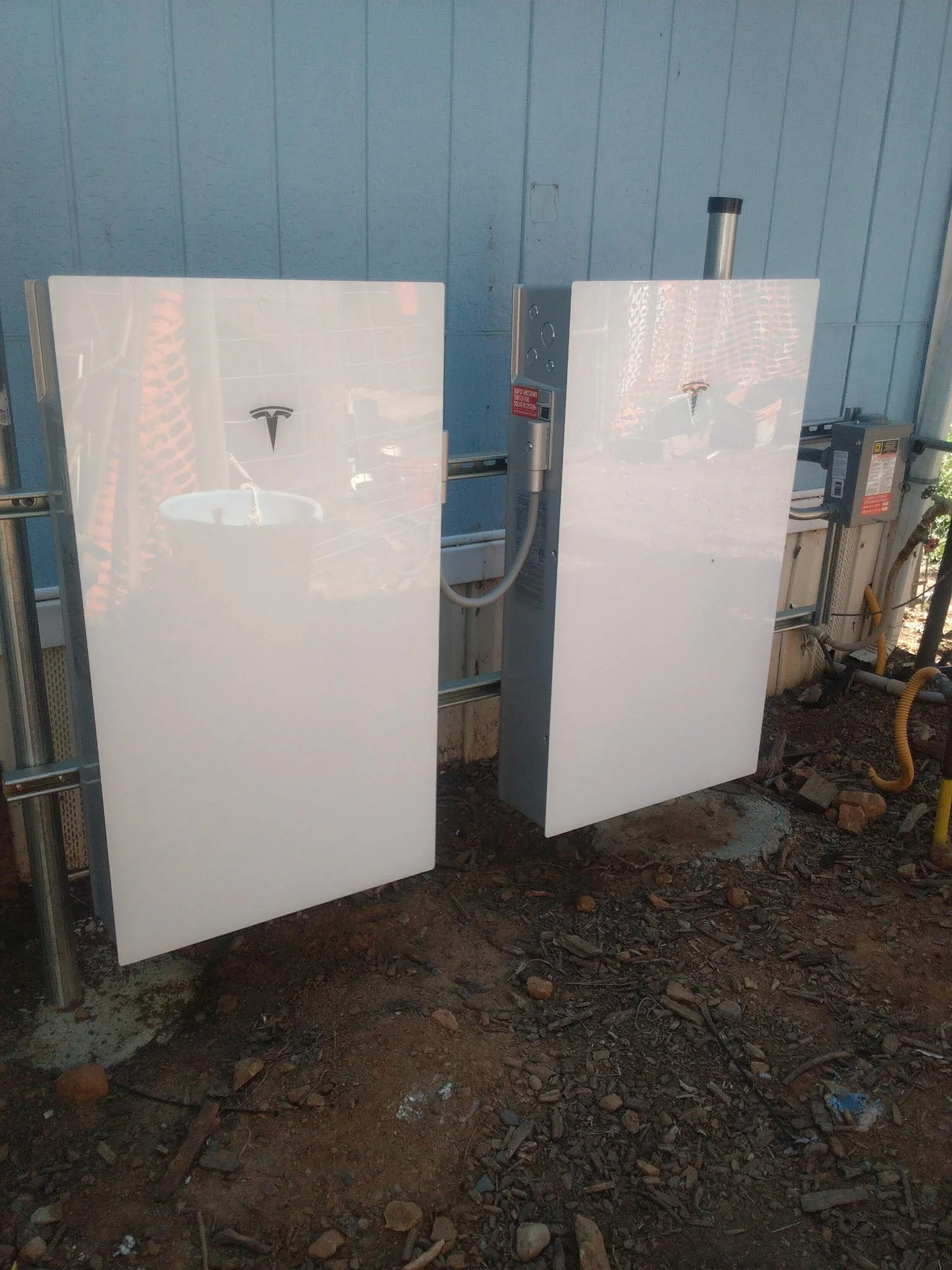
“When PG&E shut off power on our street for a wildfire shutoff, our whole block went dark. Our Powerwall kept the lights, the fridge and freezer, the heat and AC, and even our Starlink internet running the entire time. That's the part of a battery people don't think about until they need it.”— Ed Watts, Shingle Springs
Pay less for the battery up front
- Our Maxwell prepaid plan takes a big discount off solar, battery, or both
- Works with a ground mount, a roof system, or battery only
- Extra savings in qualifying energy community areas
- You own the system outright at year six
Will solar save money right away if you're on a discounted rate?
Usually not right away. CARE takes about 30 to 35 percent off your electric rates, and FERA takes 18 percent, according to the CPUC. Solar replaces power you already buy at a discount, so a new monthly payment has less to beat.
Same home, same usage, different bill
| Rate plan | Monthly bill | What solar is up against |
|---|---|---|
| Standard rate | $300 | Full-price power, the easiest bill to beat |
| FERA (18% off) | About $245 | About $55 a month less to save |
| CARE (30–35% off) | About $195–$210 | About $90–$105 a month less to save |
Simple example: the discount applied to a $300 standard bill. CARE and FERA customers also pay a lower fixed monthly charge, so real bills vary. Program details: CPUC CARE/FERA. SMUD, LADWP and other city utilities run their own discount programs.
Why it matters more for a ground mount
A ground mount already costs 15 to 25 percent more to build and starts at 8 kW. On a discounted rate, each kWh it makes is worth less to you. That's two hurdles at once.
- Your discount already lowers the bill solar is trying to beat
- A bigger, higher-cost system has to save more to come out ahead
- Extra power sent to the grid earns very little either way
What to do instead
We'll tell you straight. If solar won't save you money on a discounted rate, we'd rather say so now than sell you a system that doesn't.
Talk It Through →Can you keep solar on the roof instead of building a ground mount?
Often, yes. Many homeowners lean toward a ground mount because they want to protect a new roof or don't trust their old one. But most roof types can take panels safely, and fixing the roof first can cost less than building a ground mount.
| Roof type | How the panels attach | What to know |
|---|---|---|
| Composition shingle | Flashed mounts bolt into the rafters, sealed under the shingles. | The most common and simplest roof for solar. Check how many years the roof has left. |
| Standing-seam metal | Clamps grip the raised seams, so nothing drills through the metal. | One of the best roofs for solar. A new metal roof is usually a reason to use it, not avoid it. |
| Corrugated or ribbed metal | Mounts fasten through the panel ribs with sealed brackets. | Works well, but it does take fasteners, unlike standing seam. |
| Concrete or clay tile | Tile hooks or replacement mounts sit under or in place of a few tiles. | Doable, but it takes more labor and care because tile can crack. |
| Flat or low-slope | Tilted racks hold the panels at a better angle to the sun. | Common on additions, patios and some newer homes. |
Old roof? Replace it first
Panels last decades. If your roof needs replacing in the next several years, do it before solar so you're not paying to remove and reinstall the panels later. Read: replace your roof before solar?
Shade? Check the trees first
Sometimes trimming or removing one or two trees opens up the roof for much less than a ground mount costs to build.
Not sure what your roof can take?
We check the roof, the sun and your yard at the same visit, then show you both options side by side. Start with your system size.
What's the best way to pay for a ground mount?
Maxwell prepaid or a cash purchase. Most $0-down solar programs (PPAs) won't approve a ground-mounted system. Maxwell does, and it takes a big discount off the price up front. Roof systems have more ways to pay.
Maxwell Prepaid
A big discount off the price up front, and it covers ground mounts, roof systems and batteries.
- Approves ground-mounted systems, unlike most PPA programs
- Solar, battery, or both
- Extra savings in qualifying energy community areas, based on your address
- Maxwell insures, monitors and maintains the system for the first six years
- Ownership transfers to you at year six, at no extra cost
- Pay in full, or finance the prepaid amount through Travis Credit Union
Cash Purchase
The simplest way to buy. You own the system from day one.
- Works for ground mounts, roof systems and batteries
- You own it outright from install day
- No program approvals or third-party terms
- Pay with savings, or with a solar loan through Travis Credit Union or Credit Human
Which ways to pay work with a ground mount?
| Way to pay | Ground mount | Roof system | Battery | Who owns it |
|---|---|---|---|---|
| Maxwell prepaid | ✓ Yes | ✓ Yes | ✓ Yes | You, at year six, at no extra cost |
| Cash or solar loan | ✓ Yes | ✓ Yes | ✓ Yes | You, from day one |
| $0-down PPA | ✗ Usually not | ✓ Yes | Varies | The PPA company |
Planning a roof system instead? You'll have a few more options, including $0-down programs. See every way Californians pay for solar.
Ground mount vs roof solar: frequently asked questions
Is ground mount solar more expensive than roof solar?
Yes. A ground mount typically costs 15 to 25 percent more than the same size system on your roof. The panels, inverter and battery cost the same. The extra pays for the steel frame, foundations, trenching and a longer wire run.
Why does a ground mount cost more to build?
Because the structure has to be built from scratch. A roof system uses your house as the support. A ground mount needs engineered racking, concrete or driven foundations, a trench to your home, heavier wire for the distance, and extra plan details for the permit.
What is the smallest ground mount system you install?
8 kW. The frame, foundations and trench cost about the same at any size. Below 8 kW, the cost per panel climbs too fast to make sense, so smaller homes are usually better off with a roof system or a battery.
How high does my electric bill need to be for a ground mount?
About $300 per month or more. That's roughly 8,000 to 10,000 kWh a year with PG&E, SCE or SDG&E, which is about where an 8 kW system starts to fit. SMUD and LADWP charge less per kWh, so go by the usage on your bill there.
How much space does a ground mount need?
About the size of a two-car garage for an 8 kW array. You also need room around it for equipment access, plus any cleared space your city or county requires. Larger systems need more ground.
Does a ground mount make more power than roof panels?
Often a little more. A ground mount can be placed away from shade and tilted toward the sun, while roof panels are stuck with your roof's angle and direction. The panels themselves are the same.
How far from my house can a ground mount go?
It can sit well away from the house, but every foot adds cost. Distance means more trenching and heavier wire. The closer the array is to your electrical panel, the lower the build cost.
Do I need a permit for a ground mount in California?
Yes. Ground mount plans include foundation, racking and trench details, and some areas require a cleared zone around the array. Your installer handles the design, permits and utility paperwork.
Can I add a battery to a ground mount system?
Yes. The battery mounts at your home near the electrical panel, on a wall or a pedestal, just like with a roof system. It stores your solar for the evening peak and keeps your home running in an outage. Use our Powerwall Calculator to estimate your savings.
Will solar save me money if I'm on CARE or FERA?
Usually not right away. CARE takes about 30 to 35 percent off your electric rates and FERA takes 18 percent, so solar has a smaller bill to beat. A battery for backup, or waiting until your usage grows, often makes more sense.
Can I get a $0-down PPA on a ground mount?
Usually not. Most PPA programs won't approve ground-mounted systems. Maxwell prepaid does, and it takes a big discount off the price up front. A cash purchase or solar loan works too.
Should I put solar on my new metal roof instead?
Often, yes. Standing-seam metal is one of the best roofs for solar, because clamps grip the seams without drilling through the metal. It usually costs less than building a ground mount.
Ground or Roof? Start With the Right Size.
Your bill decides most of this. See what size system your home needs, then we'll show you whether the roof, the ground or a battery fits it best. No pressure either way.